

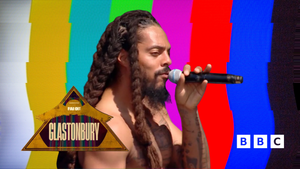
Bob Vylan have sued the BBC for defamation through the courts in Ireland and, according to the Irish Independent, it’s thought the lawsuit relates to the corporation’s “coverage of the controversy surrounding their appearance at the Glastonbury Festival last year”.
The musicians are already suing Irish broadcaster RTÉ over its coverage of the Glastonbury controversy, in which it reported that Bob Vylan had instigated an “antisemitic chant” at the festival. It seems likely that the new lawsuit against the BBC will also centre on its claims that Bob Vylan’s on-stage criticism of Israel was antisemitic.
With the BBC, it made that claim multiple times in official statements that were issued as the broadcaster dealt with the widespread criticism in media and political circles that followed its broadcast of Bob Vylan’s set.
The day after the Glastonbury Festival, the BBC said “the antisemitic sentiments expressed by Bob Vylan were utterly unacceptable and have no place on our airwaves”. And a few days later BBC Chair Samir Shah formally apologised for “allowing the 'artist' Bob Vylan to express unconscionable antisemitic views live on the BBC”.
During the band’s Glastonbury performance, frontman Bobby Vylan - real name Pascal Robinson - instigated a chant of “death, death to the IDF”, referencing the Israel Defense Forces, as well as declaring that “from the river to the sea, Palestine must be - will be - free”. However, Robinson has strongly rejected the claim that his comments were antisemitic.
And Darragh Mackin from Phoenix Law - which is representing Bob Vylan in both the RTÉ and BBC legal battles - previously told reporters that there is “a fundamental distinction between speaking critically about the role of the Israeli state forces and being antisemitic. The former is speech within the confines of political expression, whereas the latter is a form of hatred directed towards Jewish people”.
To prove defamation, it would have to be shown that the claims that Robinson made antisemitic statements on-stage were both untrue and damaging to the musician. To prove damage, Robinson would presumably try to link the broadcasters’ statements to the band losing bookings and their US visas in the wake of their Glastonbury performance.
As for proving the broadcasters’ statements were untrue, that will involve analysis of the tricky debate over if and when criticism of, and hostility towards, the state of Israel constitutes antisemitism.
That debate has been considered in the context of Bob Vylan once before, by the Dutch Public Prosecution Service. Albeit in slightly different circumstances when prosecutors in the Netherlands were tasked with deciding if Robinson making similarly controversial statements about Israel at a show in Amsterdam warranted criminal proceedings.
It decided that criminal action was not warranted because, while Robinson’s statements may have been “perceived as provocative and harsh”, they did not “constitute group defamation” or an “incitement to hatred or discrimination”, which would be required to pursue a criminal case.
The Dutch prosecutors also stressed that the band’s remarks must be considered in the context of the show. Out of context statements like “death to the IDF” and “fuck the Zionists - get out there and fight them” might seem actionable, but prosecutors concluded that they were actually “calls for activism and political involvement” which “fit with the expressive and confrontational style of the punk genre”.
It remains to be seen if either the RTÉ or BBC cases get to trial at the Irish High Court in Dublin. But if they do, the debates in the courtroom could be very interesting. And potentially as controversial as Bob Vylan's Glastonbury set.