

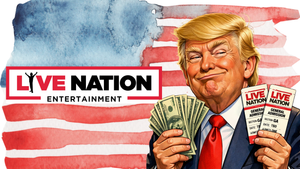
As the Live Nation antitrust trial got back underway in New York yesterday, in Washington Senator Richard Blumenthal published a timely report on the live giant and its Ticketmaster subsidiary. Given it’s titled ‘So Casually Cruel: How Ticketmaster’s Monopoly Supercharges Prices And Fees’, you can probably guess what position it takes.
In his report, the Democratic senator is highly critical of the settlement recently reached between Live Nation and the US Department Of Justice which ended the federal government’s strand of that ongoing trial.
He then has a message for the top lawyers of the individual US states - the attorneys general - who are still suing the company, and who took over leading the court proceedings yesterday, urging them to continue to push for the “break-up of Live Nation and Ticketmaster”.
The deal that settled the DoJ’s federal law claims against Live Nation is simply “the latest proof that the Trump Administration cannot be trusted to protect American consumers”, Blumenthal writes at the start of the report, which is based on an inquiry undertaken by the Senate’s Permanent Subcommittee On Investigations.
When the DoJ first sued Live Nation in 2024, accusing the live giant of anticompetitive conduct, it wanted the 2010 merger that brought Live Nation and Ticketmaster together to be reversed, and the two companies split apart once again, which was seen by many as the ultimate sanction against the company.
That sanction was “abruptly dropped” by the DoJ, however, Blumenthal says, “after Ticketmaster hired lobbyists and fixers with deep ties to the Trump administration”.
The deal the DoJ agreed to instead, he adds, involves a “meagre fine” and some nominal other operational commitments. The deal would actually see Live Nation pay out up to $280 million, but in the context of Live Nation’s annual revenues it’s a tiny amount and, even in the context of its annual profits, that’s still a fairly modest sum.
After Judge Arun Subramanian dismissed some of the legal claims made against the company before the antitrust trial got underway earlier this month, Live Nation claimed that the proposal to force a spin-off of Ticketmaster was no longer justified. Bosses then presumably hoped that the settlement deal with the DoJ meant any talk of splitting up Live Nation and Ticketmaster was well and truly off the table.
But in his report’s recommendations, Blumenthal says the results of the settlement will do nothing and, “behaviour remedies will not prevent Ticketmaster from continuing to abuse its dominance”. Therefore, and “despite the DoJ’s settlement”, the state-level AGs “should pursue nothing less than the break-up of Live Nation and Ticketmaster”.
Needless to say, a Live Nation spokesperson has already pushed back against the report, saying that it “misrepresents how the live events industry works”. But the company’s critics - including in the music industry - will be hoping the state-led legal proceedings follow Blumenthal’s recommendation.
Blumenthal’s report also shines a light on Ticketmaster’s involvement in secondary ticketing in the US, which makes it relevant to the additional and separate lawsuit being pursued against Live Nation by the US Federal Trade Commission, which accuses Ticketmaster of colluding with dodgy ticket touts or scalpers.
The document claims that “Ticketmaster used its monopolistic dominance in the primary ticketing market, and deceptive marketing practices, in order to drive more tickets in the lucrative secondary market”. The result, it adds, is that “the company has pushed for tickets to enter the resale market as soon as possible, including in some cases before those tickets were available to the general public”.
Despite the bold claims about Live Nation’s involvement in the dodgy world of ticket touting, Blumenthal’s main proposal for tackling problems around secondary ticketing is actually something that Live Nation itself now publicly supports: introducing a ticket resale price cap in law.
“Congress should consider enacting a statutory price cap on secondary ticket sales to address extreme mark-ups”, the report says. “A carefully designed cap - such as limiting resale prices to a fixed percentage above face value - could reduce incentives for large-scale scalping operations while preserving flexibility for legitimate resale”.
While Live Nation has remained much more involved in for-profit ticket resale in the US than in Europe, in recent years the company has come out in support of more regulation of the touts, including a statutory price cap.
That position means Live Nation is now more closely aligned with anti-touting campaigners within the music community, although cynics might argue that the live giant mainly supports regulating ticket resale in the hope it distracts lawmakers from regulating its primary ticketing business.
And there may well be much more distracting for Live Nation's lobbyists to do in the years ahead. The new report’s third recommendation is that “Congress should enact rules for both primary and secondary tickets targeting deceptive and abusive ticketing practices”.
Which means, whatever happens with the state-level lawyers in that New York courtroom, it seems likely Live Nation and Ticketmaster will continue to face scrutiny in Washington, at least in Congress.