

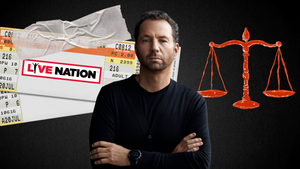
Live Nation boss Michael Rapino took to the witness stand in New York yesterday to deliver his testimony in the ongoing antitrust trial - the trial itself, and the prospect of Rapino testifying, both being things that his lawyers and lobbyists tried very very hard to stop from ever happening.
While sparring with lawyer Jeffrey Kessler - who is representing the 30+ US states that accuse Live Nation and its Ticketmaster subsidiary of anticompetitive conduct - Rapino tried his hardest to present his business as being simply a very successful player in a very competitive marketplace, rather than an exploitative monopoly that needs to be broken up, the underlying premise of the lawsuit.
Rapino highlighted that not only is his company wildly successful, but it is also a very pro-artist business to boot. Live Nation had taken a very “fragmented” live industry and “put the pieces together to make this a very global, attractive business for artists”, he told the court.
Along the way Rapino discussed his own past statements on Live Nation’s dominant position in live entertainment, his company’s ticketing deals with artists and venues, and some of the previous revelations that have come to light during the trial.
Those previous revelations included his own abrasive and forthright conversation with the boss of New York’s Barclays Center, and an exchange on Live Nation’s Slack messaging platform in which one of his employees gloated about wringing additional ancillary fees out of “stupid” ticket buyers, crowing to a colleague “we’re robbing them blind, baby!”
The top legal officials, or attorneys general, for the 30+ US states suing Live Nation claim that the company unlawfully exploits its involvement in tour promotion, venue management and ticketing to totally dominate the live entertainment market.
As a result, they say, artists and venues have little to no choice when it comes to working with the company, meaning fans also have no real choice either, and can’t easily avoid giving Live Nation money to buy tickets and attend shows in which it is involved.
According to Law360, Kessler was keen to back up that claim by bringing up past comments made by Rapino himself that seemed to acknowledge or even brag about the market dominance.
That included a comment from 2011, the year after Live Nation and Ticketmaster merged, in which Rapino boasted to investors “we have incredible market power around the world”. Rapino said he had no memory of making that claim, before conceding it was in the transcript of a 2011 investor call.
Kessler also honed in on a term used by Rapino, “self-reinforcing flywheel”, used to describe Live Nation’s strategy of using each part of its business to strengthen the other parts.
The company’s critics argue that that means venues are locked into ticketing deals in order to be able to stage shows promoted by the company’s concerts arm, artists are locked in to deals in order to be allowed access to venues for their shows, and so on.
Addressing Rapino directly, Kessler asked “you were the one who came up with the flywheel description, right?” Rapino cautiously confirmed that he probably was, but insisted that his company’s business model was entirely lawful, and that Live Nation still has strong competitors, most of whom have tried to copy his approach to the business.
Kessler also brought up claims that Live Nation had restricted a policy that had allowed artists to sell up to 8% of tickets for their shows directly to fans through their mailing lists or fan clubs. According to Rolling Stone, Rapino conceded that that policy had indeed been “modified”, but that was because rival ticketing companies were trying to access those tickets, sometimes by pretending to be fan clubs.
Kessler brought up Adele, who wasn’t allowed to sell tickets to fans directly with Songkick, even after offering to pay the fees herself. But, Rapino insisted, Live Nation’s issue wasn’t with Adele, but with Songkick. “We wouldn’t say no to Adele”, he insisted. “We said no to the ticketing company”.
Ticketmaster’s deals with venues - a key part of the legal case against Live Nation - were also discussed. Unsurprisingly, Rapino strongly denied that Ticketmaster forces venues into exclusivity deals by threatening to withhold Live Nation promoted concerts if they refuse, insisting - as his colleagues have throughout - that it’s the venues that like lucrative long-term contracts with ticketing companies.
And when it comes to arenas and stadiums across the US, Live Nation is often working with billionaires who own sports teams and, as a result, the venues that Live Nation’s concert promotions business needs access to. “I don’t tell the billionaire what to do with his venue”, Rapino said, “he tells me”.
When it comes to the key allegation that Live Nation forces venues into exclusive ticketing deals by threatening to withhold concerts, jurors previously heard from the former boss of New York’s Barclays Center, John Abbamondi, who accused Rapino himself of basically making that threat on a 2021 phone call that was played in court.
In a tetchy conversation about Abbamondi’s decision to switch his arena’s ticketing to SeatGeek, Rapino noted that a new venue was opening in New York that would increase competition. But, Rapino countered yesterday, that was not intended as a threat to the effect that Live Nation shows would go elsewhere if the Barclays Center switched its ticketing to another provider.
Plus, Rapino added, it was Abbamondi who brought up concert promotions on a call that was meant to be about ticketing. According to Bloomberg, Rapino believes Abbamondi was, in fact, employing an “entrapment strategy”. He added, “He was trying to trap me - I knew where he was headed, It was pretty obvious”.
But what does Rapino think about the “we’re robbing them blind, baby!” Slack post, shared by Benjamin Baker, a Live Nation ticketing exec, discussing with his colleagues how they were hiking up the costs of ancillary services like parking and lawn chair rental at amphitheater venues, and the fact “so stupid” ticket buyers were paying those increased fees.
Those comments were “disgusting”, Rapino said, and will be addressed this week. No disciplinary action has been taken against Baker as yet, he said, but “it’s not the way we operate” and “I’ve got it under review”, adding that he was aware that Baker apologised for his comments during his testimony to the court earlier this week.
That said, Rapino did defend the principle of his company charging for all those extra services at venues, noting that much of the ticket price from a show is handed over to the artist.
And while Live Nation did ban ticket-buyers from bringing their own chairs to its open-air amphitheater venues, forcing them into renting chairs from the company instead, that - of course - was a “safety issue”” and not a big old cash in.
So, a fun - if not exactly earth shattering - day of Rapino testimony, and presumably a sleepless night for Benjamin Baker. The trial continues - with reports that the US states could finish presenting their arguments sometime next week.