

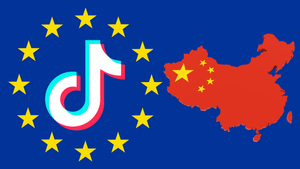
Culture ministers from across the European Union are meeting in Brussels today and tomorrow, and ahead of that meeting the governments of Germany and Austria presented a bold proposal to force TikTok Europe into European ownership, basically in the same way TikTok USA is now owned by a company controlled by American investors.
German culture minister Wolfram Weimer and Austrian digitalisation minister Alexander Pröll said in a joint statement that a “European ownership structure” for TikTok is “intended to secure control over data and algorithms and strengthen digital sovereignty”.
Other EU states are being encouraged to back that proposal which, needless to say, will be strongly opposed by TikTok and its current owner, China-based ByteDance.
Germany and Austria are also reportedly backing another proposal to be discussed in Brussels this week which calls on the European Commission to draft new legislation to boost copyright protection across the EU in the context of artificial intelligence, another set of proposals that will be opposed by big tech.
ByteDance’s ownership of TikTok has long been a cause of concern for governments in many countries, which fear the Chinese government has access to TikTok user data from around the world.
In the US those concerns led to Congress passing a law in 2024 stating that, within the American market, TikTok could not be controlled by a Chinese company, and if ByteDance failed to sell the business to allow that to happen the app would be banned.
ByteDance insisted that meeting the requirements set out by Congress - meaning that TikTok would be run differently in different countries - was logistically impossible and pursued every legal route possible to try and block the law. But without success. And ultimately that argument turned out to be a big old bluff.
Because, in the end. ByteDance did sell the TikTok US business to a company controlled by American investors. By the time that happened Donald Trump was President, meaning TikTok USA ended up being controlled by a bunch of Trump's billionaire buddies. Which may or may not be less problematic than having a Chinese owner.
In a statement published yesterday ahead of the EU culture ministers meeting, Weimer and Pröll set out very similar concerns about ByteDance’s ownership of TikTok to those expressed by members of US Congress back in 2024.
“Large digital platforms, through their ranking and recommendation systems, significantly influence which content people see, how widely it is shared, and how much attention it receives”, they write. Ownership structures, access to data and control of the algorithm, they add, “affect media diversity, the reliability of information, democratic decision-making, and thus the functioning of our participatory society”.
They then state, “If these essential factors of social coexistence are determined by non-European digital companies, which in turn are subject to the control of autocratic actors, then action is clearly needed”.
TikTok’s European operations are already regulated by EU law, including data protection law and the Digital Services Act. And those regulations have been enforced against TikTok. The Irish Data Protection Commission fined the social media company €530 million for allowing Chinese ByteDance staff to access European user data, and the European Commission has launched investigations under the DSA.
Weimer and Pröll say that those investigations illustrate the “urgency” of the situation, but that the “systemic risks” caused by ByteDance’s ownership of TikTok go “far beyond” what EU data protection law and the DSA are designed to address.
“A fundamental solution”, they add, “should therefore address the root cause of this threat to Europe: the Chinese parent company ByteDance, its alignment with Chinese interests, and the resulting, persistently unclear access by the Chinese state to the data of millions of European users”.
“By establishing a European ownership structure for TikTok’s operations in Europe”, they go on, “and thereby simultaneously placing the essential technological infrastructure under European control, we would be taking a significant step towards genuine European digital sovereignty”.
When ByteDance was fighting the change in ownership requirements in the US in 2024 it did look like the whole thing could result in TikTok going offline in America - and indeed it did, for about twelve hours in January 2025. Had TikTok gone offline for any real length of time, that would have been a big deal for a music industry that relies on TikTok as a crucial marketing and fan engagement tool.
But given ByteDance’s stance in the US turned out to be a bluff, that outcome seems unlikely in Europe even if Germany and Austria can find more support for their proposal across the EU.
Nevertheless, TikTok will do everything it can to block the change in ownership plan, insisting that all the concerns over the Chinese government having access to its user-data are invalid. A TikTok spokesperson has already told Politico that Weimer and Pröll’s proposal has “zero merit”.
Eleven EU states are backing the separate call for the European Commission to draft legal reforms to boost copyright protections in Europe in the context of AI.
According to Euronews, a document endorsed by culture ministers in those eleven countries says “since AI has moved from pure research into broad practical application, it has led to profound upheavals in human creative processes and the perception and experience of art and culture”.
The extent of those upheavals, they add, “is becoming increasingly clear”, which makes the “need for action more urgent”.
A lot of this comes down to the copyright and transparency obligations of AI companies when they copy existing content in order to train AI models. Many AI companies do that without permission, but the copyright industries - including the music industry - insist that constitutes copyright infringement.
The existing EU AI Act does say some things about copyright and transparency, but the copyright industries argue those rules do not go far enough. Meanwhile many AI companies claim the text and data mining copyright exception in EU law covers AI training.
These issues need addressing, the culture ministers say, adding, “we call on the European Commission to present a legislative proposal as soon as possible”.
These demands will be welcomed by the music industry, although Euronews notes that there is division within many EU governments on copyright and AI, with business departments often siding with AI companies and culture departments with creators and rightsholders.
So even if discussions in Brussels this week make it sound like conversations in the EU are moving in a positive direction for the music industry, nothing is really assured at the moment.
==
Germany and 10 other EU countries urge the Commission to propose new legislation protecting copyright in the age of AI, ahead of a Culture Ministers’ meeting on Thursday.
Germany and 10 other member states are urging the European Commission to table new legislation to safeguard copyrighted works in the age of artificial intelligence.
Germany, Spain, Poland, Austria, Cyprus, Croatia, Denmark, Estonia, Portugal, Slovakia and Slovenia have thrown their weight behind stronger protection for the cultural and creative sector as AI technologies advance.
“We call on the European Commission to present a corresponding legislative proposal as soon as possible,” reads a note the 11 countries submitted for the agenda of the Culture Ministers’ meeting on Thursday and Friday.
Advanced AI systems such as large language models are trained on trillions of data points, scraped from the open internet among other sources, often with little regard for whether the material is protected by copyright.
For the tech sector, restricting access to copyrighted material would leave Europe further behind the US and China in the AI race. For the creative and cultural industries, current practices amount to mass theft and undermine their livelihoods.
“Since AI has moved from pure research into broad practical application, it has led to profound upheavals in human creative processes and the perception and experience of art and culture. Its extent is becoming increasingly clear, and the need for action more urgent,” the document continues.
Balancing technological innovation with the protection of human-created content also divides national governments, where economy ministries tend to side with start-ups and culture ministries with creators.
The initiative is the latest push by the supporters’ culture ministries for a new legislative tool to shield copyright holders from the data scraping of AI developers. It follows a similar call in May by eight countries, showing the initiative is gaining support.
“The aim is to protect human creative work while enabling AI innovation in Europe. European innovation and AI development require fair competition and a level playing field with non-European providers, irrespective of where the AI was developed and, in particular, where it was trained,” the document states.
The Commission is due to present a legislative package on digital transformation, simplification and copyright in the second quarter of 2027, according to its work programme.
Earlier this month, the EU executive closed a public consultation on possible measures to strengthen copyright protection, including the use of protected content in AI.
The EU already has a Copyright Directive, which allows creators to opt out of having their work used to develop AI. In the note, the countries call for swift action to make that opt-out easier to enforce.