

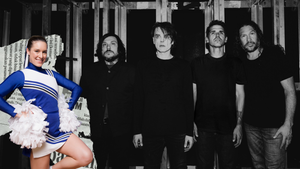
My Chemical Romance have agreed to change the costumes worn by dancers performing in their current run of shows at the Hollywood Bowl following legal action from the Dallas Cowboys Cheerleaders. Those dancers were dressed to look like members of the cheerleading squad during a routine that begins with some cheerleading and ends in a pretend gun battle between the dancers and the band’s members.
Pro Silver Star, a company that manages the cheerleading squad’s brand and owns various trademarks connected to it, launched legal proceedings against the band last week, accusing them of false association, trade dress infringement and trademark dilution by tarnishment, all because they dressed their dancers to look like they were cheerleaders for the Dallas Cowboys football team.
Pro Silver’s legal filing provided some detail of the cheerleading routine within MCR’s Hollywood Bowl shows, which are part of the band’s tour marking the 20th anniversary of 2006 album ‘The Black Parade’.
The dancers appeared during a rendition of the song ‘Teenagers’ dressed in costumes that, the legal filing explained, “copied the Dallas Cowboys Cheerleaders uniform’s signature elements: white boots, white shorts, a blue blouse tied above the midriff, and a white vest adorned with blue stars”.
Audience members were “left in no doubt about who the performers were meant to be”, the filing continued, because “as the costumed performers cheered across the stage, frontman Gerard Way told the crowd, ‘Thank you, Dallas’”. The band then handed the dancers rifles and they and the band’s members “joined a staged firefight” during which the dancers “depicted being shot and crawling off the stage”.
Alex Spiro, the lawyer representing the cheerleaders in the short-lived dispute, insisted that his clients were not usually litigious and stated that Pro Silver “takes no issue with MCR’s music, its artistic ambitions, or any message defendants seek to convey”.
Nor did the cheerleading brand owner “ask defendants to change their setlist, narrative, politics, choreography, or even their decision to put gun-toting performers on stage”, it just wanted the dancers to “not wear the Dallas Cowboys Cheerleaders uniform while doing it”. This was not a big ask, the lawyer added, because “the universe of alternative costume designs is effectively unlimited”.
Had the case proceeded to court, it would have put the tension between trademark law and First Amendment free speech rights back in the spotlight.
An often cited principle in that kind of dispute is the Rogers Test, stemming from a 1980s legal battle involving the actress and dancer Ginger Rogers. Under that test, if a trademark features within a creative work, it is generally not considered trademark infringement if the use is “artistically relevant” and doesn’t “explicitly mislead consumers”.
In its legal filing, Pro Silver stressed that audience members at MCR’s shows, as well as online commentators, “understandably believed” that the dancers “were the real Dallas Cowboys Cheerleaders and said so in social media posts that continue to circulate”.
Whether that would be enough to demonstrate that MCR had “explicitly” misled audience members we'll never know, given that - according to TMZ - the band quickly settled the matter and agreed to change how the dancers are dressed at shows due to take place later this week.
Despite US judges having to balance trademark rights with free speech rights whenever a company’s brand or identity is used in a creative work, the American entertainment industry has often been cautious about featuring recognisable brands in shows or programmes that are in any way contentious or controversial. Though online creators are not always so careful.
As the Dallas Cowboys Cheerleaders were busy objecting to MCR’s cheerleading routine, security company Allied Universal was suing YouTube creator Chad Lebaron over video sketches he posted featuring a character dressed in that company’s uniform behaving inappropriately.
Those sketches, the security firm claims in a lawsuit, associated the company’s brand with “sexual misconduct, predatory behaviour, abuse of authority, harassment and criminal conduct”, and are “fundamentally inconsistent with the professionalism, integrity, trustworthiness, and authority associated with Allied Universal and its personnel”.
It is also suing for trademark dilution by tarnishment as well as straightforward trademark infringement. We’ll have to wait and see whether that case proceeds to a point where the Rogers Test is being employed in court.