

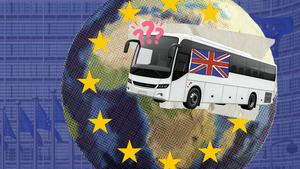
The music industry has expressed disappointment that last Friday’s UK-EU Summit did not result in tangible measures to address the issues created by Brexit for British artists and crews touring Europe.
Those issues got a mention in the statement issued by the UK and European Union on Friday, but the only commitment made was to “explore further mutually beneficial solutions” at some point in the future. This despite the Labour Party specifically mentioning “touring artists” when committing to “tear down unnecessary barriers to trade” in the EU ahead of the 2024 General Election.
In a statement, the Independent Society Of Musicians says it is “deeply disappointing to see no movement on the barriers to touring in the EU”. UK touring artists, it adds, “are suffering under the current arrangements every day and we urgently need the government to make good on its manifesto pledge to find solutions”.
Meanwhile, building on that loose commitment to “explore solutions”, UK Music has urged UK and EU leaders to “begin formal talks on specific solutions as swiftly as possible so we can see some tangible progress and a road map to solving these problems”.
After the 2025 UK-EU Summit, a nine page ‘Common Understanding’ document was published that said “the European Commission and the UK recognise the value of travel and cultural and artistic exchanges, including the activities of touring artists”, and to that end “they will continue their efforts to support travel and cultural exchange”.
This time, in their joint statement, the European Commission and UK government said they “reaffirm the value of cultural and artistic exchanges, including the activities of touring artists”, before adding that commitment to “explore further mutually beneficial solutions”.
So, I suppose, things have moved on from “continued efforts to support” to “committing to explore solutions” - and getting the word ‘solutions’ in there is progress of a sort - but not that much really when it’s not yet clear what those solutions are or when they may be agreed let alone implemented.
Friday’s statement did then point to the first post-Brexit ‘high level meeting on culture’ between the UK and the European Commission that took place back in March, stating that this will now become an annual event, and suggesting - if you’re wanting to be extra optimistic - that that could be the forum where actual solutions to the post-Brexit touring problems get properly discussed.
The issues created by Brexit for British performers and their teams have been widely documented, and include issues around travel permits, customs procedures, transport and haulage restrictions, and tax complexities. Those issues result in extra costs and bureaucracy which - for some artists - means a European tour is no longer commercially viable.
A report commissioned by the UK government and published earlier this year revealed that the total number of performances by British artists in Europe in 2024 was 21% down compared to 2019, ie before the UK exited the EU.
And, in terms of the economic impact of the additional post-Brexit touring costs and bureaucracy, the same report estimated that the UK music industry and other performing art sectors together lost £208 million in ‘gross value added’ and about 2490 jobs between 2022 and 2024.
Creator groups across Europe came together through the Cultural Exchange Coalition ahead of last week’s summit calling for action, with an open letter declaring that “culture is Europe’s most powerful connector”.
And yet, it added, “current arrangements for touring and other forms of creative collaboration are weakening that connection and undermining a sector that delivers economic value, global influence and shared cultural understanding”. But that call for action didn’t really push any of these issues up the agenda.
If you insist on staying optimistic, both the UK and the EU agree that closer ties in general are a good thing, and maybe that means more can be achieved at the specific culture meeting next year.
And there were some more tangible positive developments announced on Friday around opportunities for young people and in education that could benefit some in the music community. But any optimistic view on addressing the post-Brexit touring issues requires taking a much longer term perspective.
And yet, both ISM and UK Music stress the urgency when it comes to addressing those issues. UK Music CEO Tom Kiehl says, “every year of delay brings hugely damaging economic consequences for our sector, impacts millions of music fans and makes cultural relationships harder to repair”.
With that in mind, he adds, “we need Prime Minister Andy Burnham and his government to introduce measures to support UK artists and businesses with the additional costs they currently face and honour its manifesto promise to bring down barriers to touring”.