

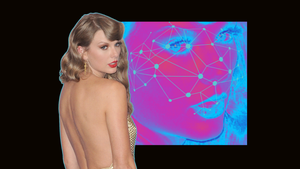
Taylor Swift has applied to trademark her voice and likeness in the US, seemingly in a bid to use trademark law to combat unapproved AI-generated digital replicas and deepfakes. The actor Matthew McConaughey previously did something similar and confirmed his trademark registrations were to provide protection in relation to AI-generated imitations of his image and voice.
These moves come as governments and lawmakers in multiple countries, including the UK, consider whether new legal protections are necessary to help performers, and people more generally, protect their voice and likeness in the context of AI. But while those discussions proceed, more artists may look to register new trademarks that could help them protect their interests in the AI domain.
US attorney Josh Gerben, who spotted Swift’s trademark registrations, writes in a blog post that “the filings arrive as AI-generated content continues to create problems in the entertainment industry”. Actors and musicians, he adds, “have increasingly found their voices and images used in unauthorised videos, songs and digital content that is created by AI and circulated online”.
Swift can’t use trademark law to generically protect her voice or likeness, instead she is seeking protection for specific sounds and images. The sounds are spoken word audio clips of Swift saying the phrases “hey, it’s Taylor Swift” and “hey, it’s Taylor”. As part of her registration she’s provided promo clips made for Amazon and Spotify in which she says those words.
Gerben describes the specific image that Swift is seeking to protect in his blog post. It’s a picture, he says, in which the musician is seen “holding a pink guitar with a black strap, dressed in a multi-colored bodysuit with silver accents and boots”, a look that is “closely associated with her recent performances”.
However, Gerben explains, getting protection for these specific sounds and images could provide more extensive protection for Swift as she seeks to stop unofficial AI-generated digital replicas.
“By registering specific phrases tied to her voice”, he writes, Swift could “potentially challenge not only identical reproductions, but also imitations that are ‘confusingly similar’, a key standard in trademark law”.
Therefore, in theory, “if a lawsuit were to be filed over an AI using Swift’s voice, she could claim that any use of her voice that sounds like the registered trademark violates her trademark rights”.
As performers look to protect and monetise their voice and likeness in the AI domain, copyright, personality rights, personal data rights and trademark law may all be relevant, as well as things like defamation and the principle of passing off.
To develop an AI model that can output content imitating Taylor Swift’s voice or likeness, you likely need to copy recordings and videos featuring Swift into a training dataset.
If that requires the permission of the relevant copyright owners - which the music industry argues it does - then copyright provides some protection, because Swift or her business partners could decline to grant permission for those copies being made.
However, many AI companies argue they don’t need permission from copyright owners for AI training, because such activity is covered by copyright exceptions or the US principle of fair use. And even if that’s not true, performers in the music industry don’t necessarily own the copyright in all their recordings and videos.
As a result, performers have increasingly looked to personality rights - sometimes called publicity rights - to allow them to control use of their voice and likeness. Although quite how personality rights work differs around the world - and in the US from state to state - and they don’t exist in some countries, including the UK and Ireland.
Some countries, including the US, Denmark and the Netherlands, are actively considering new rights specifically to deal with AI-generated digital replicas. And the UK government has identified digital replicas as one of the areas of focus as it consults further on AI and creator rights.
But what about trademark law? Although trademark is more commonly used to protect names, logos and slogans, it can also be used to protect sounds - which is where Swift’s application to register here two audio clips comes into play.
Stuart Casey from London-based law firm Spencer West LLP tells CMU, “applying to register particular sounds as trademarks is not new - think of the distinctive ‘ta-dum’ each time you stream Netflix or the roaring lion associated with MGM”.
However, he adds, “Taylor’s team will need to show that her voice - as a sound trademark - is distinctive and is capable of distinguishing her goods and services from others - in short, that sound must be her brand identifier”.
“Whilst that may appear to be a relatively easy hurdle for her”, he goes on, “there will be challenges not just in accurately describing the sound but also in showing that the phrase is not simply part of her ‘product’”.
And, he says, “when it comes to enforcing her rights in an age of AI-created media, showing that the trademark is being used in an identical or confusingly similar way is also likely to be difficult in all but the most clear cut of uses”.
However, it may be that Swift’s team reckon they can better protect her voice and likeness from unapproved AI uses if they have multiple legal protections in their arsenal, including copyright and trademark, as well as publicity rights and any new digital replica rights.
And it seems likely more artists will be investigating the role of trademarks in the AI domain.
Dorothea Thompson, a partner at law firm Bray & Krais, tells CMU, “We are currently advising talent clients - both UK and US based - as to what extent their existing trademarks may be used against AI uses, and whether they should seek additional registrations for this purpose. Matthew McConaughey’s registrations have stimulated the conversation and we expect that to amplify following Taylor Swift’s new filings”.
She adds that “it’s worth noting that this application is so far untested and it will be interesting to see how far these rights can be stretched”.
However, she goes on, “trademark registration remains relatively low cost - particularly in the UK - so it’s worth exploring for more established artists. And registration may also give talent leverage in AI licensing discussions. Following the recent deals licensing music for AI uses, we may also see licensing of ‘personality’ elements too, which could provide another passive income stream to artists”.