

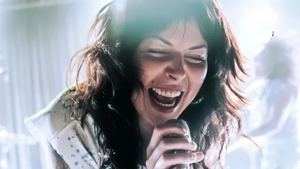
In a world where it’s hard to keep up with all the boycotts artists are meant to be joining right now, Alexis Krauss from Sleigh Bells has provided a frank explanation about why - for many artists - it’s actually quite hard to cut all ties with platforms like Spotify and companies like Live Nation, even if you have strong concerns about the way those businesses behave.
Despite being in a band that “has tried to treat people ethically” and “work with individuals and companies that share our values and act with integrity”, Krauss writes in an Instagram post, “I find myself often beholden to corporations and systems that prioritise profit over ethics”.
She goes on, “Would I love to take our music off Spotify? Yes I would. Can we afford to lose the platform Spotify gives us? No we can’t. It would be devastating for us. Would I love to never support Live Nation and Ticketmaster again? Sure I would. Is it possible for a band that barely breaks even touring? No. I can’t even fathom how we would do it. We just don’t have that type of leverage”.
Krauss’s post was presumably prompted by the current controversies surrounding her band’s booking agency Wasserman Music, after the most recent release of Epstein files included old emails from more than two decades ago between the agency’s CEO, Casey Wasserman, and Epstein accomplice and convicted sex trafficker Ghislaine Maxwell.
“Would I love to just leave Wasserman Music? Yes I would”, Krauss writes. But, “can we?” No, because she has “love and respect” for the individual Wasserman agent which represents her band.
And, of course, when it comes to booking agents, artists really sign with the individual agent, not the agency they happen to work for. And when it comes to Krauss’s individual agent, “I trust him to make the decision that is best for himself, his family and his artists”.
A growing number of mainly independent artists have decided to pull their music from Spotify in the last year or so, usually putting out accompanying statements setting out their reasons for boycotting the platform.
In many cases they are protesting the investments made by Spotify founder and former CEO Daniel Ek in defence technology company Helsing, and/or the streaming company running ads for the US government’s ICE agency. Although some artists simply boycott Spotify to protest inequities in the streaming business model.
However, for many mid-tier artists, boycotting Spotify is tricky. For starters, a label may control their recordings and decide where those recordings are streaming. But even where that’s not the case, artists may be relying on even modest monthly Spotify income to have a viable artist business.
Spotify is the global market-leader in music streaming and, in some countries, completely dominates the market. Pulling your music from Spotify doesn’t mean you’ll see an uplift in streams on other platforms, especially if a lot of your Spotify income comes from the passive listening of a small number of tracks that do well in the algorithm or have been added to lots of personal libraries.
And for a lot of mid-tier artists, every revenue stream - however modest - is often crucial to ensure you can continue to make and perform music for a living. Some artists may be able to make up the difference by directing fans to superfan offerings on platforms like Bandcamp, but that’s far from assured.
On the live side of the business, an artist might have issues with the market dominance of Live Nation and its Ticketmaster business. But because of that market dominance - across venues, festivals, tour promotions and ticketing - it’s more or less impossible to tour above the grassroots level without coming into contact with Live Nation at some point, especially in the US and the UK.
Another area where boycotts have become the norm of late is festivals, with artists urged to pull out of certain events because of their sponsors or corporate owners.
While, unlike with Spotify and Live Nation, in theory it is easier to avoid individual events on ethical grounds, boycotting festivals - especially at the last minute - can still cause financial losses that artists can’t really afford, or scupper carefully planned marketing strategies impacting on other revenues.
Krauss doesn't discuss festival boycotts in her post, but does reference another area where - in theory - it is easier for artists to turn down deals on ethical grounds: that being sync.
But again, can an artist’s business take the hit? “Have my values aligned with every sync we’ve ever approved?” Krauss asks, before admitting, “no they haven’t”. But “does that income enable me to pay mine and my child's health insurance every month? You bet it does”.
“Call me spineless but this is my truth”, Krauss continues. “This is the hypocrisy of our realities, as we try to do the least harm in an unscrupulous system. Could I do more to hold these individuals and corporations accountable? Absolutely. Do I have the capacity to? No I don’t”.
She goes on, “in my opinion it’s not the responsibility of the artists, especially those struggling to make a living, to fix these broken systems”. Which isn’t to say artists are entirely “powerless”, but “without systemic change and accountability for those at the highest levels of power, no meaningful change is going to occur”.
Maybe the “multimillion and billionaire artists” could do more “to hold these institutions accountable”, and Krauss says that she wishes that they would. “I’m always grateful when an artist uses their platform to disrupt the status quo”, she adds.
But, crucially, “none of these corporations are going to bat an eye if Sleigh Bells bails on them. It’ll just leave us losing more money on tour and making less streaming income than we do now. It’s a shitty place to be but it’s the truth. What we need is greater regulation and accountability at the highest levels of the industry”.