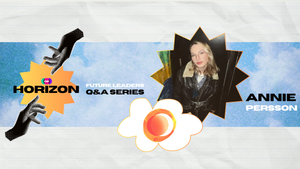
As part of our Horizon Future Leaders series of interviews, we are connecting with the music industry’s next generation of leaders to gather candid advice and insights into their career journeys. ~
This week, we caught up with Annie Persson, who works as a manager at Solar Management.
From confidently asking a fellow fresher if she could manage them to now operating at the centre of a fast-moving roster at Solar Management, Annie Persson’s career is built on a simple principle: take the initiative to create your own hands-on experience rather than waiting for a blueprint that doesn’t exist.
She didn’t have a clear path into music management, so she made one. She ran open mic nights that turned into a gig series, joined an electronic music collective that tried (and sometimes failed) to set up a label and club nights, and started managing an artist days after meeting them. Not everything worked, but it all counted.
Now she’s at Solar Management working across artists, producers, songwriters and composers, often juggling multiple roles at once, overseeing releases, coordinating sessions, pitching for sync and effectively project managing the many moving parts of her clients’ careers.
What’s particularly useful about Annie’s advice is how honest she is about the landscape right now: more educational opportunities but fewer entry-level roles, salaries that haven’t kept up with the cost of living, and competition that makes privilege a bigger factor, and puts up extra barriers for many people.
Her response? Show up anyway. Build a community of people you genuinely click with. Be reliable, accountable and honest. And understand that how young people work and consume music is what’s shaping the industry, even when you’re the one hustling for internships.
Read the full Q&A with Annie below 👇
What’s your current role in the music industry?
I’m a manager and day-to-day manager at Solar Management, working with artists, producers, songwriters and composers. Most of the clients I work with do all the above.
What does your general day-to-day look like?
My days vary depending on what projects we have running and whether we are in the middle of an artist album campaign or tour.
We run in-house labels for many of our clients, so one minute I am pulling the right teams together for a release and discussing music video ideas, the next I may be marking up producer or composer deals, registering and confirming cue sheets or songs, along with coordinating writing and recording sessions, or pitching for sync briefs.
It is the mix of creative thinking, people management and admin that ties it all together. When I explain my job to someone outside the industry, I usually say it’s like I am a project manager supporting our clients in running their businesses.
I am lucky to work so closely with and learn from the legends Carol Crabtree, Solar’s founder and MD, and Gunther Walker, business affairs and senior manager at Solar.
What steps did you take early in your career to gain the experience and skills that led to your current position?
I did a BA in Music Business at BIMM London and just got stuck right in from the start - I went to every event and gig I could and signed up to every industry newsletter and networking event I could find.
I ran an open mic night with fellow students for a few nights that turned into a quarterly gig series. I joined an electronic music collective where we attempted to set up a label and run club nights. Some of the efforts were far from successful, but they were all adding to my experience and CV.
Most importantly, I started managing an artist. We met at freshers and I asked a few days later if I could manage her. We learned SO much together!
What early opportunities did you explore that were particularly valuable?
Speaking to recruiters early on was very helpful. It takes some time to adapt to the industry culture, and they can give guidance on what skills are in demand and how to frame your strengths. Shout out to Catriona Loggie at BIMM and the team at BIY People & Talent.
Joining the MMF! The MMF consistently provide educational and networking opportunities; they are the common denominator to many of my industry relationships.
I did a few different internships in management and PR, and volunteered at events and festivals. If you are at uni and have been given the opportunity to do work experience, really take advantage of it. I use skills I learned in the mix of these experiences every day.
How has the opportunity landscape changed since then?
There seems to be more educational opportunities, but the same amount of, if not fewer, entry-level roles. Young people are struggling to find full-time employment in the industry.
Once they get there, entry-level salaries often have not been adjusted to the rising cost of living, and the competition is high, so there is also an issue of privilege breaking through this glass ceiling.
As a response to this, I see many graduates starting their own businesses and freelancing, especially in social media management and digital marketing. There seems to be a knowledge gap to be filled in the industry, especially around social media.
Are there specific internships, projects, or initiatives you would recommend to newcomers?
There is no blueprint for getting into music management. A first step is to just create your own hands-on experience, running a club, gig or open mic night, and offering to help a new artist you know or like.
I think people often forget that we have almost unlimited resources to learn on the internet; you can find books and YouTube videos about almost anything you would like to research.
Most management companies take work experience/interns, but they do not always advertise. Reach out to them or find a connection with someone you know who can introduce and recommend you. I would also reach out to independent managers directly to offer help; they are always in need of a pair of extra hands.
Interning or working in a different part of the industry is also useful to get an insight into how it is to work with a manager, for example, from a label and PR perspective.
What advice do you have for building and leveraging a professional network in the music industry?
Show up! You will get to know so many people and learn by just showing up. Say hi and smile even if the other person doesn’t remember you. It’s okay, they probably will next time.
Grow a community of people you genuinely click with - you will support each other along the way, even if you don’t know how yet. Often, that eureka moment comes a few years later and you end up working on an exciting project together.
Most people are drawn to the music industry because of their passion for music - we all have this in common, which is easy to forget when you get drawn into the hard work!
How has the evolving digital landscape impacted your role, and how do you stay ahead?
Our work and focus are constantly shifting, and because so much of what we do is digital, you must be ready to adapt to new platforms and technologies all the time.
Almost everything runs through some kind of online system - collecting societies, label accounting, publishing, DSPs, endless portals and backend systems. For me, learning how things work technically is the best way to understand how to use them strategically.
Reading up‑to‑date best‑practice guides from DSPs and social platforms - ideally straight from the source - removes the guesswork and lets you build a strategy that serves your objectives.
I think it’s essential to engage with fan communities - online and offline - you can’t advise artists if you don’t understand their audience. Follow the rabbit holes, what platforms are they using, how does their feed look etc. We have so much data available to use; we often just need to find an angle to it, and sometimes it takes trial and error.
Which brings me to the AI conversation: I am putting effort into learning how to use AI safely and effectively. Understand how it works, the ethics and the impact of the tools you choose. To be clear, this is not for AI to create music but to be used for sorting and sourcing data, and for the tasks that often fall to the bottom of the to-do list.
What trends do you see on the horizon, and how can early-career professionals prepare for them?
More effective use of AI in the industry for administrative tasks might lead to cutting out entry-level and assistant jobs that traditionally have been the gateway to a music career.
However, the reality is that most management assistants express that they are overwhelmed and overworked, so anything that helps them work smarter is useful. There are massive opportunities to use technologies in everyday work and to solve industry-wide problems that are yet to be explored, and the next generation are likely to be ahead when it comes to AI use.
There is always a new shift in music consumption habits on the horizon. Keep your ear to the ground, learn and explore new platforms, and direct-to-fan opportunities, and reach out to new companies that you think are creating something interesting.
How young people work and consume music is what is shaping the industry; it is also easy to forget that when you are hustling for internships and applying for several jobs every day.
What is one piece of advice you wish you had received at the start of your career?
If you are reliable, accountable, honest and genuinely doing your absolute best, things will fall into place. Do what you say and say what you do.