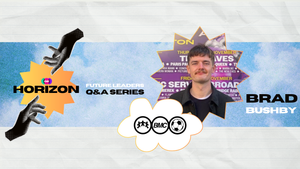
As part of our Horizon Future Leaders series of interviews, we are connecting with the music industry’s next generation of leaders to gather candid advice and insights into their career journeys.
This week, we caught up with Brad Bushby, freelance events and tour representative and founder of the Brighton Music Cup.
Working across touring shows while building his own grassroots initiative, Brad’s perspective spans both the operational realities of live music and the cultural ecosystems that sustain it.
As a tour rep, he represents promoters on the ground - advancing shows, coordinating between artist teams, venues and production crews, and ultimately ensuring that everything from technical specifications to show-day problem solving runs seamlessly.
Alongside that work, Brad founded the Brighton Music Cup - a community-driven project that sits at the intersection of music, football and local culture, designed not just as a one-day event but as a platform that champions Brighton’s grassroots scene and strengthens the networks around it.
Brad’s path into the industry came through deep immersion in the environment itself. Rather than waiting for formal entry points, he spent time in venues, at shows and around the people shaping the scene, treating every experience as an opportunity to observe and learn.
That willingness to be “comfortably inexperienced”, as he puts it, became a key driver of growth, reframing mistakes as data and exposure as education.
In our conversation, Brad reflects on the value of volunteering at events to understand how shows actually run, the importance of learning practical skills like grant writing, and why building and nurturing community is key. He also points to the growing cultural crossover between music, sport and lifestyle, and why early-career music industry professionals should pay attention to the spaces where those worlds meet.
For anyone starting out, his advice is simple: embed yourself in the culture, stay curious, and don’t wait for permission to start building something.
Read the full Q&A with Brad below 👇
What’s your current role in the music industry?
I’m the founder of the Brighton Music Cup, and a freelance events/tour rep.
What does your general day-to-day look like?
No two days are ever the same and that’s precisely what I thrive on.
As the founder of the Brighton Music Cup, my focus is community architecture. I’m constantly engaging with venues, artists, promoters and local partners to ensure the project doesn’t just exist as a one day tournament, but as an ongoing platform that champions Brighton’s grassroots music ecosystem.
That might involve securing brand activations, developing partnerships, planning tournament logistics, curating line-ups or creating meaningful touch points that extend the event’s cultural footprint. It’s about building something that has both social value and long-term resonance.
In my role as an events and tour representative, the emphasis shifts toward precision and delivery. I work on behalf of promoters to ensure productions run seamlessly, acting as the bridge between artist teams, tour managers, venues and local crews.
My responsibility is to protect the show: operationally, commercially and reputationally. From advancing technical specifications to troubleshooting on show day, the objective is always the same, to create an environment where artists can perform at their best and audiences experience something exceptional.
What steps did you take early in your career to gain the experience and skills that led to your current position?
I immersed myself completely.
Early on, I made a conscious decision to understand the ecosystem from the inside out. I attended shows across every level, from grassroots venues to larger touring productions, not just as a fan, but as a student of the culture. I observed how rooms were run, how artists were treated, how audiences responded and how communities formed around certain spaces.
Equally important was community engagement. I introduced myself to people, asked questions, offered help, and made it clear I wanted to contribute rather than simply benefit. That proximity to the scene allowed me to absorb the nuances, the etiquette, the pace, the politics, and the energy that you can’t learn from the outside.
Understanding culture is fundamental in music. You can’t operate effectively in it unless you’ve genuinely embedded yourself within it.
What early opportunities did you explore that were particularly valuable?
Observation was one of my greatest teachers.
I paid close attention to people who were operating at a high level - promoters, tour managers, venue operators - and consciously built a kind of internal “conglomerate” of influence. I identified what worked: The calm authority, the decisiveness under pressure, the creative risk-taking, the way they built trust. Then I filtered it through my own personality.
I also said yes to experiences. Not recklessly but deliberately. I understood early on that growth comes from exposure. I was comfortable being inexperienced, because I reframed it as learning rather than failing. Every show, every meeting, every mistake became data. That willingness to try, refine and improve accelerated my development significantly.
How has the opportunity landscape changed since then?
It’s far more decentralised and that’s exciting.
The industry feels increasingly DIY, in the best possible sense. Independent operators now have access to tools, platforms and audiences that were previously gate-kept by major institutions. Distribution, marketing, analytics, direct-to-fan engagement, the infrastructure is accessible.
The power dynamic has shifted. You no longer need permission to build something meaningful. If you have a clear identity, a strong network and the discipline to execute, you can create genuine momentum independently. That shift has allowed projects like the Brighton Music Cup to exist and flourish outside of traditional frameworks.
Are there specific internships, projects, or initiatives you would recommend to newcomers?
Absolutely! Arts funding bodies, such as Arts Council-backed initiatives, can be transformative if approached strategically. Learning how to write a grant application is a valuable skill in itself; it forces clarity of vision and operational planning.
Mentorship programmes are also powerful, particularly those that connect emerging professionals with experienced operators. Having access to perspective can shorten your learning curve dramatically.
Volunteering at events and festivals remains one of the most practical entry points. Being on the ground understanding accreditation systems, production schedules, artist liaison, crowd flow gives you real world insight that no classroom can replicate.
What advice do you have for building and leveraging a professional network in the music industry?
Be authentic. Be kind. And be consistent.
The music industry is both expansive and incredibly small, reputation travels quickly. If you operate with integrity and treat people well, it compounds over time.
It’s also important to be clear about what you’re building. When you articulate your vision confidently and take pride in your work, people understand how they fit into it. Share your projects. Speak about them with conviction. Enthusiasm is contagious when it’s genuine.
Relationships should never be purely transactional. Focus on adding value to the rooms you enter. The building blocks follow naturally.
How has the evolving digital landscape impacted your role, and how do you stay ahead?
The digital landscape has fundamentally changed representation and connectivity.
Access is immediate. Communication is faster. Audiences are more informed. As an events and tour rep, that means expectations are higher and information must be accurate, responsive and aligned across multiple stakeholders in real time.
For the Brighton Music Cup, digital channels allow us to build narrative, not just awareness. Community is no longer confined to physical space; it lives online year-round.
Staying ahead requires attentiveness. I pay close attention to how audiences engage, how artists communicate and how cultural conversations evolve. But ultimately, digital tools are amplifiers that can’t replace authentic connection. They enhance it.
What trends do you see on the horizon, and how can early-career professionals prepare for them?
The intersection of sport, music and lifestyle culture is becoming increasingly influential particularly in football.
Football is no longer just a sport; it’s a cultural language. We’re seeing deeper integration between clubs, artists, fashion and community initiatives. That crossover presents powerful opportunities for storytelling and audience expansion.
For early-career professionals, the key is to think laterally. Understand adjacent cultures. Study how brands and artists collaborate beyond traditional gig formats. The future belongs to those who can build experiences that sit at the intersection of multiple cultural touchpoints.
What is one piece of advice you wish you had received at the start of your career?
In the words of Elijah, “Close The App, Make The Thing”.
Don’t wait for perfect timing, perfect confidence or external validation. Momentum is built through action. You refine through doing.
If you have an idea, build it. If you want to be in a room, go. Courage compounds and so does experience.