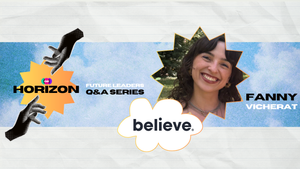
As part of our Horizon Future Leaders series of interviews, we are connecting with the music industry’s next generation of leaders to gather candid advice and insights into their career journeys.
This week, we caught up with Fanny Vicherat, Head Of International Programs - Editorial & Marketing Partnerships at Believe.
From reposting music on SoundCloud to managing streaming strategy for international priorities at one of the world's largest music distribution companies, Fanny Vicherat’s path into the industry is a reminder that the door often opens from unexpected directions.
She’s honest about the fact that none of it was particularly strategic at first - instead she had genuine curiosity and a willingness to get involved in things she cared about. Those early personal projects and collective connections turned out to matter more than any formal strategy would have done.
Fanny’s also clear-eyed about what the industry looks like right now: fewer opportunities, more competition and teams that are shrinking. Her advice isn’t to panic, but to pay attention - particularly to the smaller, independent structures that are quietly reshaping how the industry actually operates - and to build the kind of hands-on experience that makes you stand out before you’ve even sent in an application.
Read the full Q&A with Fanny below 👇
What’s your current role in the music industry?
I handle the streaming strategy for our ‘international priorities’ as part of the Editorial & Marketing Partnerships (EMP) Team at Believe. I work across both our distributed and in-house labels, covering projects from all around the world.
What does your general day to day look like?
It really depends on the day, but it’s usually a mix of data analysis, especially early in the week, to track how our priorities are performing across DSPs and markets. I spend some time in internal meetings with my counterparts around the world, as well as external ones with DSP partners. My days also involve listening to upcoming projects, setting targets, pitching and reviewing campaigns.
What steps did you take early in your career to gain experience and build skills to get you where you are now?
It wasn’t something I planned very strategically at first. While I was still studying, I got involved in music through personal and associative projects that I genuinely enjoyed.
I spent a lot of time on SoundCloud reposting music and eventually caught the attention of an online curator channel, which led me to help manage one of their accounts. Through that experience, I met people in the music industry, including a Paris-based collective I worked with for several years.
What opportunities did you explore early on that were particularly valuable?
These personal projects were extremely important as one opportunity really did open the door to the next. They helped me land my very first internship at Believe, where I met many people, including my manager at the time, whom I followed and worked with for several years.
Has the opportunity landscape changed since then?
I think it was already very much a “right place, right time” industry, but I wonder if it’s not even harder now for younger generations to break in. There are fewer opportunities and more people wanting to work in music.
In France, for example, there are now several schools focusing on music business programmes, which didn’t really exist before. It’s great for learning and understanding the industry, but it also increases competition in a landscape where teams are often shrinking.
Are there any specific internships, projects, or initiatives that you would recommend to newcomers looking to pursue a similar role?
Anything you can do on your own before applying for internships is extremely valuable. Get involved with collectives in your hometown, help artists around you, and reach out to people for calls or coffee chats to understand their roles.
I always love seeing candidates who have taken initiative, someone passionate and motivated really makes the difference. I’m often impressed by how many great projects and connections some people build before even landing their first job.
What advice do you have for building and leveraging a professional network in the music industry?
Honestly, I try not to force networking and keep things as genuine as possible. Very basic advice, but: be nice to everyone, at every level. The intern you meet today could be your colleague, client or even your boss tomorrow.
Don’t be afraid to check in from time to time, grab lunch, send a quick message, or go to shows. People might not remember you and that’s okay! It’s totally fine to politely remind someone that you crossed paths on a specific project or through a mutual connection, most of the time, they do remember after that.
How has the evolving digital landscape impacted your role, and where do you focus to stay ahead?
It’s had a massive impact, my job evolves every year, so it’s hard to answer briefly.
The DSP landscape is completely different from when I started: more competition, less attention, new consumption habits, less editorial curation, more algorithm-driven discovery, more genres to represent, new tools, and new platforms.
I’ve always worked in streaming-focused roles, so I naturally evolved with these changes. I also try to stay curious and make a point of learning about areas outside my direct role, like marketing or social media, to understand the bigger picture rather than focusing only on pure streaming.
What trends or changes do you see on the horizon for the music industry, and how can early career professionals prepare for them?
With the layoffs we’ve seen across the industry, and the lack of existing opportunities, more and more people are launching independent businesses. Some are highly specialised, while others offer more “à la carte” support for projects.
We can already see how this is changing the way the industry operates, not only hiring external PR teams but also marketing, content creation for socials, artist services, or consulting.
My advice would be to keep an eye on smaller structures, stay curious, and reach out to people working on projects that genuinely excite you.
What’s one piece of advice you wish someone had given you at the start of your career?
Be curious, meet people and surround yourself with those you like and admire. You’ll have a lot to learn, so stay humble and patient, but remember that you also bring a lot of value. Whether it’s a niche genre you know inside out or a new platform no one else is using yet, don’t be afraid to speak up :)!!