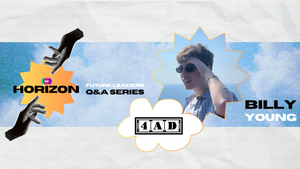
As part of our Horizon series of interviews, we are connecting with the music industry’s current and next generation of leaders to gather candid advice and insights into their career journeys.
This week we caught up with Billy Young, publicist at 4AD, one of the most beloved and artistically distinctive record labels in the UK, where they handle UK press and coordinate international press for the label’s roster, as well as working on selected AD 93 releases.
Billy’s path is a great example of what happens when you couple hard work with following what you genuinely love rather than chasing a pre-determined career plan.
They started a live music night in the basement of their student house, not for work experience, but to build friends and community around music. Some of the up-and-coming bands that played are now thriving in the scene.
From there, casual volunteering for Bird On The Wire led to them forwarding on an apprenticeship opportunity at 4AD, which was entry level, educational and, by their own admission, hard work. Completing a diploma while working almost full time on a completely new and full-on job wasn’t easy, but it was an efficient way to learn fast.
The through-line in everything Billy does is community. Their focus in their professional life now, just as it was when running that basement gig night, is building friends and community around music.
It shows in how they approach the role, meeting journalists for coffee, seeing artists perform, finding unconventional angles for experimental campaigns, and mediating sensitively between artists and press with genuine care for both sides.
Their advice is refreshingly open-ended: follow what you enjoy, connect to and believe in. They’re glad nobody gave them more specific advice at the start and they’d only encourage others to do the same.
Read Billy’s’s Horizon Future Leaders Q&A 👇
What’s your current role in the music industry?
I’m a publicist for record label 4AD, where our team handles UK press and coordinates international press for artists signed to the label. I also work on selected AD 93 releases.
What does your general day to day look like?
Most days I’ll be in the 4AD office, which feels like a second home to me.
I have to monitor my emails a lot, as I get a lot of queries and requests that need quick answers, like sending albums to reviewers or press photos to editors for features.
I send a lot of emails too, which can make you feel a bit annoying and needy, but between the two labels there’s a lot happening and you want to make sure everything is on the radar of editors and journalists.
If we’ve had any announcements or releases that week, I’ll need to monitor what’s run in print and online and keep our reports up to date to send to artists’ managers and my colleagues at the label.
I also schedule and coordinate interviews for artists globally, working across many time zones and communicating between our amazing colleagues across the world.
When I need to write a pitch or a press release, I’ll put headphones on and try to not look at my emails for an hour or so. I really like the writing element of my role – especially if it’s informative or needs to communicate something to serve a specific purpose.
I studied philosophy and I really enjoy structuring sentences and using words to convey meaning or information.
There’s a lot of putting out fires and mediating, being the person communicating between artists and the press. For an artist, promoting work can be sensitive and personal, and when touring and working on a campaign they can get very burned out.
At the same time independent music publications need support, and are often understaffed, working with limited budgets. Sometimes mediating between them is challenging, especially when each side is pushing back on what they need, but we do our best to be fair.
I also need time to think and research, working out who might be a fan and who might be interested in covering something. Especially on campaigns that are a bit more experimental or unconventional, sometimes you need more of an unconventional approach.
I’m really interested in this, for certain campaigns I’ve found experimental publishing houses, or tapped into niche online communities.Sometimes I’ll be out of the office to oversee in-person interviews or photoshoots. I’ll also sometimes meet a journalist for coffee or lunch – I try to meet people in real life as much as I can, as part of my enjoyment of the role is getting to build those relationships.
As much as possible I’ll see our artists perform, as it’s the music itself and the community that comes with it that makes it all worth it for me.
What steps did you take early in your career to gain experience and build skills to get you where you are now?
When I was a student and in my early twenties, I started a live music night in the basement of my student house. Some of the up-and-coming bands that played are now thriving in the music scene.
I didn’t necessarily do it for work experience, I did it to build friends and community around music. But I think this set me up for the music industry the most – getting to know the scene, building a network of artists and music lovers, taking risks, trying things and learning about what I was good at.
I also think that in my music industry professional era now, my focus is still building friends and community around music.
What opportunities did you explore early on that were particularly valuable?
After engaging in the DIY scene, I did some casual volunteering for Bird On The Wire, hoping to get a job there initially, but it was them who forwarded on the opportunity at 4AD.
It’s so nice how following one opportunity can lead to another that eventually becomes the right fit. The opportunity at 4AD was through an apprenticeship scheme, so it was entry level and educational. It was hard!
I had to complete a diploma whilst working full time - almost - on a completely new and very full-on job. But it was an amazing and efficient way to quickly learn about how a record label works.
Has the opportunity landscape changed since then?
I’m sure it has, even in the four years since I applied for the apprenticeship scheme, but there are still people offering entry level positions and there’s still a thriving DIY scene that people are doing wonderfully creative things in.
It’s hard and competitive, and sometimes you have to carve out the opportunities for yourself that you wished were already available, but that’s what keeps the industry alive.
Are there any specific internships, projects, or initiatives that you would recommend to newcomers looking to pursue a similar role?
The Beggars internship, as it’s six months long and paid at London living wage, and you spend time in each of the departments to get an overview of how a label works structurally and what specific roles you might be most interested in pursuing.
The staff at Beggars are such good people, and care very deeply about helping you get started in your career. Even if there’s not a job at the end, you’ll have built relationships with so many incredible and influential people that will give you the best start to the industry you can hope for.
What advice do you have for building and leveraging a professional network in the music industry?
Be yourself, be kind, be creative, and connect with people about the thing you love. And if music is for everyone, then the music industry needs to be for everyone.
How has the evolving digital landscape impacted your role, and where do you focus to stay ahead?
The evolving digital landscape means that the media landscape is constantly and quite radically changing, including how artists promote music and how audiences discover and connect to artists.
I try to keep up with trends and make sure we’re not being left behind, such as engaging in the social media and music influencer world, whilst also staying connected to more traditional forms of media. Staying open minded and positive about the directions we’re going in is important, as is not seeing new trends as absolute.
Media has always been continuously changing and not necessarily going in a certain direction, and things do sometimes circle back around, so you never know where we’re headed next. Keeping alert, open and flexible is the best thing you can do as a PR in a fast-changing media landscape.
What trends or changes do you see on the horizon for the music industry, and how can early career professionals prepare for them?
The music industry is also changing quite rapidly with the way that people are consuming music. It can be hard to predict where things will go, but putting artists first and letting them lead the way will always lead you in the right direction.
What’s one piece of advice you wish someone had given you at the start of your career?
I’m actually quite glad that nobody gave me any specific advice early on. I found my career by following what I enjoyed, connected to and believed in, so I’d only encourage people to do the same!