
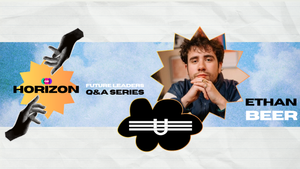
Our Horizon series catches up with the music industry’s current and next generation of leaders for some honest advice on how they got where they are.
This week it’s Ethan Beer, Head Of Press at Underplay. Alongside leading the press team, he manages a brilliant roster with Bathing Suits, Jessica Winter, Kamran Khan, pencil and Melin Melyn, running press campaigns and artist management side-by-side. By his own account, most days end at a gig.
He got his start on Big Creative Education’s music business apprenticeship at Republic Media, and he’s upfront that growing up just outside London and living at home made that possible. But he’s a strong advocate for more paid, entry-level opportunities for people outside the M25, and it’s great to hear someone in his position championing it.
On press, he has a sharp read on where things are heading: with influencers now steering how younger audiences find music, experienced music journalism matters more than ever for cutting through the digital noise.
However, for anyone building a career, he points to social media, digital advertising and influencer marketing as the skills the industry values most right now.
His wider advice is simple: find your people, do things together, say yes as much as you can, and remember it’s meant to be fun. It’s clearly worked for him. In 2025 he got to go to Glastonbury for the first time with a band he manages.
Read Ethan’s Horizon Leaders Q&A 👇
What's your current role in the music industry?
I'm currently Head Of Press at Underplay. As part of my role there, I also manage acts like Bathing Suits, Jessica Winter, Kamran Khan, pencil and Melin Melyn.
What does your general day to day look like?
From a press perspective, it’s usually making journalists’ lives a pain by emailing them, setting up features, album reviews and such. There’s the occasional trip too.
Management is totally different, and one of the best parts is that every day is different. You’re helping with creative, doing admin, building a campaign, playing therapist or listening to new music. And it probably ends with a gig in the evening!
What steps did you take early in your career to gain experience and build skills to get you where you are now?
I'm incredibly lucky I grew up just outside London - shout out Hayes/Slough! - and could live at my parents’ house whilst I enrolled in Big Creative Education’s (BCE) music business apprenticeship.
I got an apprenticeship at a company called Republic Media, where I started to learn about the music industry hands-on, and did one day a week at college learning the “theory” of it. There need to be more programmes and paid opportunities for people outside the M25 to get their first break in music.
What opportunities did you explore early on that were particularly valuable?
The BCE apprenticeship scheme was an amazing first step. I met some great people who are still working in music, at some big companies and in some big roles. I just wanted to try everything, say yes to everything I could and be confident enough to make some mistakes early. The only real way to learn the music industry is to DO things!
Has the opportunity landscape changed since then?
People just have less money and things cost more, so taking a low-paid, entry-level job in music has become much harder for working-class people. But the internet, and social media in particular, has also democratised everything.
A great example is Private Reg / Regcords – a Leeds-based DIY label/management/live bookings one-man band. He’s just gone out and done things and created a community in his local scene, and it’s starting to make moves outside Leeds.
In an increasingly online world, I think the majority of people invested in art and music are searching for real connection and community. Be that person!
Are there any specific internships, projects, or initiatives that you would recommend to newcomers looking to pursue a similar role?
BCE’s music apprenticeship course and Generator’s programmes in the north of England are two great courses I’d recommend if you can apply. But I think cold emailing companies whose work you love, and doing your research, is still a possible entry point.
What advice do you have for building and leveraging a professional network in the music industry?
Just be normal! And find like-minded people and do stuff with them. One of the best parts of the music industry is being able to be creative with your friends. Start the band. Put on the gig night. Go to the ‘dry’ networking event and try to forget about the schmoozing.
When I first moved to London, I just found cool gigs, hung out in the smoking area and started meeting the same few people. We’re still friends to this day. Although I wouldn’t recommend taking up smoking!
How has the evolving digital landscape impacted your role, and where do you focus to stay ahead?
In press, the landscape changes every few years. We’re definitely in a boom of influencers/content creators talking about music on Instagram and TikTok.
That’s where a lot of kids are finding music recommendations from the next generation of tastemakers, so a lot of the job is navigating that and building up a new bank of relationships. But that means traditional media and writing from experienced music journalists have never been more important for cutting through the digital noise.
These things come in cycles, though, and we’re already seeing a response in the number of independent print zines being published. It’s a really exciting and vibrant place for journalism – it’s just tricky to monetise, so my heart goes out to all the people doing it just because it needs to be done!
In terms of management, it feels like every day there’s a new thing to learn.
A lot has been written about “bot accounts” and “astroturfing”, and I think there’s a big difference between that and simply making lots of content and testing what works. Trial reels and full feeds seem to be a necessity, but faking an audience isn’t.
Either way, if you’re reading about the latest tactic from me you’ve probably missed the boat. The next thing is around the corner.
What won’t ever die is real-life experiences, amazing gigs and moments where fans can truly feel like they’re part of an artist’s journey, and I think as the digital detox movement continues to build we will see more of these experiences from bigger acts.
That’s something we definitely try to focus on more at Underplay.
What trends or changes do you see on the horizon for the music industry, and how can early career professionals prepare for them?
It would be remiss not to talk about how AI is going to affect everyone’s career on an industry-wide scale. I fear that soon not only will the music we listen to be made by AI, but AI will also control the way it’s delivered to consumers.
If it were up to me there would be serious restrictions on it, but it seems like the cat is already out of the bag. So becoming at least savvy in using AI agents would be a good piece of advice. Learning how they work, how they can improve workflow and how they can be applied to certain sectors of the music industry - ideally not the creative part.
Understanding the inner mechanics of social media, digital advertising and third party marketing via influencers would be a good place to research too, as these are the roles being valued more industry-wide.
What's one piece of advice you wish someone had given you at the start of your career?
Don’t forget, the whole point of this is that it’s supposed to be fun! You have to really want to live and breathe music, and all the other stuff that comes with it will just be background noise.
I never thought I’d want to be a music publicist, let alone a manager, and in 2025 I got to go to Glastonbury for the first time with a band I managed. It’s funny where this business can take you if you say yes and try out as much as you can. Good luck!