

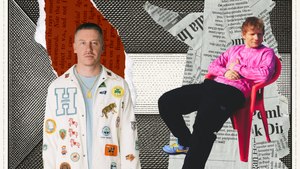
Macklemore has issued a lengthy statement after being kicked off Ed Sheeran’s current US tour over his on-stage support for Palestine. Promoters of Sheeran’s ‘Loop’ tour were forced to remove Macklemore as the support act at eight upcoming concerts after receiving an ultimatum from the owners of several of the stadiums that are hosting the shows.
Sheeran himself also issued a statement this afternoon, confirming that “after Macklemore’s performances at my New Jersey shows” earlier this month “venues on my upcoming tour dates communicated that they would pull the shows if he was still supporting”. He says he tried to find a compromise position without success, before insisting that “Macklemore coming off tour was the promoter’s decision, it was not mine”.
In his statement, Macklemore notes that he has been expressing support for Palestine on stage for three years without too many issues, but it has now become a major controversy because he is “sharing a stage with one of the biggest artists in the world, in some of the biggest stadiums in America”. And “at a certain level of exposure”, the statement ‘Free Palestine’ becomes “too much of a risk”.
Because, he goes on, if he kept making that statement at shows this size, and “with Ed implicitly supporting it” and “with the crowd getting loud and showing undeniable support for Palestinian liberation”, then “what artist might speak out next?” The stage “becomes resistance” he goes on, adding “maybe that’s why this time it became so important to silence me”.
As is usually the case when artists use their platform to criticise Israel and support Palestine, Macklemore was both commended and condemned by different groups over his on-stage remarks at two Sheeran concerts earlier this month.
At both those shows, Macklemore made a short speech expressing support for Palestine and also screened footage of the ongoing conflict in Gaza during a performance of his pro-Palestine protest song ‘Hind’s Hall’.
Some of the critics called for the rapper to be dropped from the eight future Sheeran shows he was booked to play, with the Israeli American Council launching a petition to that effect. Meanwhile, campaign group StopAntisemitism said in a statement that “Jewish fans bought tickets to see Ed Sheeran sing - not to be ambushed by Macklemore’s anti-Israel propaganda”.
Amid the inevitable allegations that his on-stage comments were antisemitic, Macklemore also used his second Sheeran support slot to address his “Jewish brothers and sisters” in the audience, insisting that “criticism of Israel, criticism of apartheid, being against genocide, is in no way a criticism of you”. Though that did little to placate the critics.
Among those strongly criticising Macklemore was businessman Robert Kraft, a vocal supporter of Israel, whose company owns one of the stadiums Sheeran will play later this month, the Gillette Stadium in Foxborough, Massachusetts, home of the New England Patriots American football team.
In his statement, Macklemore says Kraft contacted Sheeran and said the rapper would not be allowed to perform at his venue. And not only that, Kraft had also “rallied some of the other stadium owners and collectively they gave Ed an ultimatum: if Macklemore stays on the tour, you will not be allowed to play in our venues”.
Sheeran’s US promoter the Messina Touring Group has also confirmed that it was the stadiums that forced them to remove Macklemore from future shows.
It told Rolling Stone, “we have been notified by venues on the upcoming US tour dates that they will not allow a concert to take place with Macklemore on the line-up, which would result in the cancellation of the tour and impact hundreds of thousands of fans”.
As a result, and “after discussions with stakeholders”, the promoter added, “Macklemore will not be performing on the remaining support dates”.
Once an artist starts playing stadiums in the US, they are often booking venues from sports teams and billionaires rather than music companies like Live Nation and AEG, and the people running those stadiums probably see less need to placate artists whose politics they may disagree with, especially support acts.
Which possibly influenced Team Sheeran and the Messina Touring Group’s decision to not call Kraft’s bluff in a bid to defend their support act’s freedom of expression. Presumably fearing that multiple stadiums might in fact go through with their threats to cancel the upcoming shows, causing all sorts of logistical and financial nightmares.
Though, of course, Sheeran will know that complying with Kraft’s demands to drop his support act will prompt lots of public criticism from those who support Macklemore’s stance.
In his statement earlier today, Sheeran is careful to acknowledge the ongoing conflict between Israel and Palestine, and the suffering on both sides, without expressing any opinion on the politics. He writes, “I have my personal views on this devastating conflict. Just because I choose not to speak publicly, it doesn’t mean I don’t have them, and it doesn’t mean I don’t care. Nor does it mean I don’t support causes in my own, personal way”.
He goes on, “There is a reason I do not use my professional platform for politics - my audience includes young people, often children, of all backgrounds. Those who come to my shows do not expect a political forum”.
While he “respects” Macklemore’s “strength of purpose to stand up and shout for what he believes”, he argues that “there is room for multiple approaches to the same end: peace. I choose to use my fame and platform to be a place of safety and sanctuary, to maintain diplomacy and keep conversations open, not closed. If we only focus on shouting the loudest, nothing will ever change. There are different approaches to being an advocate for change”.
In his statement Macklemore says he understands Sheeran’s position, even though he feels very differently. After discussing his long friendship with Sheeran, he says that “Ed was in a fucked up position” once Kraft made his demand that the rapper be dropped for the shows, because Sheeran’s “typical apolitical stance” was “being challenged in a way it never had been before”.
Revealing a little about his conversations with Sheeran in the last week, he goes on. “He told me that the words ‘Free Palestine’ and the image of the Palestinian flag were hurtful to a lot of people he spoke with”.
“I told him that if those words were more offensive than tens of thousands of Palestinian children being killed by Israel, then there was a fundamental disconnect between where those people stood and where I stood. But he couldn't get past his public facing, ‘I don’t take sides’”.
“And I get why people don’t”, Macklemore continues. “Taking a side can cost you. Money, brand deals, sponsorships, festivals, private shows, relationships and access”.
“I’ve lost all of those things”, he adds. “But there is no neutral position between the oppressor and the oppressed. When one side has the bombs and bottomless financial and military support from America, refusing to take a side doesn’t leave you in the middle”.
Having started his statement by stressing that “I am not a victim, Ed Sheeran is not a victim, the victims are the Palestinian people”, Macklemore finishes by writing that the two shows he go to perform with Sheeran were enough because he got “two chances to stand in front of 90,000 people and say the words that somehow became too dangerous to say: Free Palestine”.
He concludes, “But if those words cost me the stage, while turning the conversation back to Palestine, then it was the most successful tour I’ve ever been on”.