

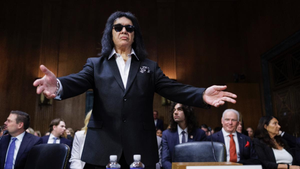
It was Gene Simmons’ turn yesterday to tell US Congress why American radio stations should finally start paying royalties to artists and record labels, rather than continuing to exploit a rather large and lucrative loophole in US copyright law.
Unlike most countries, US law does not provide the owners of sound recording copyrights with control over the conventional broadcast of their music, meaning American AM/FM radio stations do not need licences from, or to pay any royalties to, the record industry. Efforts to bring American law in line with the rest of the world by introducing radio royalties were in the spotlight yesterday in the US Senate.
“American artists have never been paid for radio airplay - not one cent”, Kiss member Simmons told the Senate’s intellectual property committee. Meanwhile, he added, “radio made $14 billion this year - billion with a B”.
“They play our songs”, he went on. “People tune in to hear our songs. Advertisers pay big money to reach those listeners. And the artists who created the music that makes it all work? They get bupkis. I don't know about you, but where I come from, that’s called robbery”.
The record industry has campaigned for decades to get radio royalties in the US, with numerous rock stars and pop stars stepping forward to make the case for why broadcasters should pay artists and labels, as well as songwriters and music publishers, who do earn royalties from US airplay. Frank Sinatra famously fronted one campaign back in the 1980s.
The arguments used by the radio stations back then for why they shouldn’t have to pay royalties to artists and labels are more or less the same as the arguments they are employing now. Principally that airplay is important promo for artists and labels, and therefore they shouldn’t expect to get paid for being played too.
Speaking for the National Association Of Broadcasters at the Senate hearing yesterday, Henry Hinton from radio company Inner Banks Media wheeled out that classic argument. “When our listeners hear a new artist or song they like on the radio”, he told senators, “they often engage with that artist in other ways - by streaming the music, following them on social media or attending live events”.
“That ripple effect”, he went on, “generates significant income for performers through the promotional value of radio”. And, he insisted, “the mutually beneficial relationship between performers and radio - free airplay for free promotion - continues to thrive”.
That said, Hinton spoke more yesterday about the role radio stations play in their local communities, basically telling Congress members that that community support role would be threatened if broadcasters were forced to pay royalties to artists and labels.
Obviously, the NAB deliberately put forward Hinton, as the boss of a small independent radio business with just five FM stations, rather than a major player in US broadcasting like iHeart or Cumulus Media, in a bid to ramp up that “we're part of the local community” element of the argument.
The record industry rejects the doom and gloom predictions that paying modest royalties to artists and labels would massively impact on the local programming of radio stations, as well as the long-standing argument that the promo value of airplay should be payment enough.
The latest proposals to reform US copyright law are contained in a thing called the American Music Fairness Act. Both Simmons and Michael Huppe, boss of US collecting society SoundExchange, urged Congress to embrace that act during yesterday’s session.
Huppe told Senators: “Congress has stepped up time and again to modernise the law to ensure that artists are paid when their music is played on digital, satellite and streaming services, but it has yet to fix this problem for FM radio. We’re asking you to finally close this glaring loophole in our copyright law which has been giving one of the oldest music delivery platforms a free ride for far too long”.
