

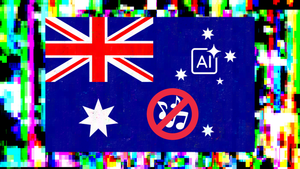
AI-friendly copyright reforms being considered in Australia - which would make it easier for AI companies to use existing content in AI training, via what would basically be a statutory licensing system - might not apply to music, according to sources who have spoken to the Australian Financial Review this week.
That would mean AI companies in Australia could scrape the internet for written and visual media, and use that content for AI training, in return for making payments into some kind of collective licensing system, but they wouldn't be able to make copies of music. For that, they would need to secure bespoke licences from the music industry.
These revelations emerged just as all the creative and media industries in Australia, including the music industry, came together to launch a campaign to oppose the AI-friendly copyright reforms being considered by the country’s government. And one independent Australian senator, David Pocock, has suggested the newly proposed carve out for music might be an attempt to divide that united front.
Meanwhile the music industry, for now at least, remains committed to the joined up campaign, with the boss of record industry trade group ARIA - Annabelle Herd - calling the proposed carve out “unworkable”, and adding, “we stand with the rest of the creative and media industries”. AI companies must get explicit permission before training with any copyright protected works, and that principle is “fundamental”.
What we know about the copyright reforms being considered by the Australian government has mainly come from a series of leaks and media reports.
A year ago the country’s Attorney-General Michelle Rowland said the government would not introduce a new copyright exception that would allow AI companies to do whatever they want with existing content when training their generative AI models. And then in July Prime Minister Anthony Albanese said “no company should use Australian books, music, art or news to build or train AI without the artist’s control".
But in recent months it’s become clear that Australian ministers are considering copyright reforms under heavy lobbying pressure from the AI sector, amid promises from some of the big US tech companies that Australia could become a key secondary base for their operations if copyright rules can be relaxed.
It’s thought that Albanese and his team favour some kind of statutory licensing system - even if they won’t call it that - which would allow AI companies to use existing content for AI training in return for buying a ‘permit’, money from which would flow to creators and rightsholders.
There would also likely be an option for rightsholders to opt-out of the system, so that their content could only be used if a bespoke licence was secured. Major rightsholders would almost immediately opt-out, but ministers possibly assume that independent and especially individual rightsholders would find it easier to stay in the system and get their share of what money is generated by the permits.
Politically speaking, Rowland and Albanese seem to think that supporting this approach doesn’t break their previous promises around copyright exceptions and artist control.
The government is also likely to push out a narrative that, under the current system, Australian creators and rightsholders earn nothing because AI companies currently train their models in the US where they can rely on the fair use principle. Which means they don’t need to have rightsholder permission or to pay any licensing fees. So any payments via this proposed new system would be a win.
But, of course, that narrative falls down because - as far as the creative and media industries are concerned - AI training does not actually constitute fair use under US law, and dozens of lawsuits in the American courts centre on that dispute. If the copyright industries ultimately win those lawsuits, they will seek trillions of dollars in damages from the AI companies.
This week’s revelations that the proposed statutory licensing system in Australia could exclude music is interesting. Is that because big pop stars have been particularly vocal in their opposition to any AI-friendly copyright reforms? This week’s new joined-up campaign against the proposed reforms coincided with ARIA’s big annual awards event, and lots of music artists gave the campaign their formal backing.
That included Elton John, who sent in a recorded message for the awards show. In it he said, “I want to send an important message to the Australian government. You have a duty to protect Australian artists and their work. Don’t let AI use any Australian artist’s work without full permission. Please, protect the next generation of Australian artists”.
The music carve out proposal may also be a sign that the big US AI companies pushing for the copyright reforms - especially Anthropic and Open AI - are less concerned about having free access to music. Although both have copied lots of lyrics without permission and have been sued over that fact. But then, it may well be that any music carve out only applies to compositions and recordings, not lyrics.
As the copyright obligations of AI companies are evolved and clarified - whether through judgements in court or legislative reforms - it may be that the rules will differ for different kinds of work. The written word, after all, often contains facts and information which is not, in of itself, copyright protected, whereas that's generally not the case with visual works, and especially not with musical works.
That said, all the copyright industries are adamant that AI training requires permission and therefore licences, and it seems likely that will remain the position for the foreseeable future. Though whether formal AI copyright proposals that carve out certain artforms will ultimately impact on joined-up lobbying campaigns remains to be seen.
Responding to the rumoured music carve out, senator Pocock told the AFR that the proposal seems like “some sort of divide-and-conquer strategy”. He added, “We need to be backing all of our creatives and standing up to US tech companies who are stealing their work, monetising it and, I think, really, in a way, denigrating music creativity”.
Meanwhile ARIA boss Herd also pointed out the complexities of the carve out plan. She told AFR, “Once the AI companies can legally scrape content at scale, carve-outs become extremely difficult”. Not least because, “music lives inside TV shows, films, ads and radio broadcasts” and “if those aren’t carved out, the music in them gets scraped too”.
Therefore, Herd concluded, “our position is unchanged: we stand with the rest of the creative and media industries - permission is fundamental”.