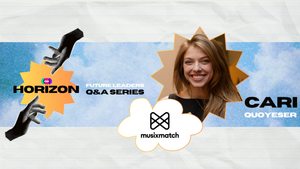
As part of our Horizon Future Leaders series of interviews, we are connecting with the music industry’s next generation of leaders to gather candid advice and insights into their career journeys.
Cari Quoyeser's path to her current role was uniquely varied: gigging, touring, managing her own band, competing on ‘American Idol’, working as a session vocalist for the Houston Texans, and even serving as a lyricist and dialect coach for a Belgian artist during the pandemic.
Now she’s Sales Manager in Partnership Solutions at Musixmatch Pro, working with labels, distributors, publishers and artists to help them get more value from their lyrics, while still working as a songwriter, lyricist and session vocalist on the side.
That dual perspective, one foot in the creative world and one in the commercial side, is exactly what makes her good at her job. She understands both the art and the business well enough to actually advocate for solutions that serve creators.
Her advice for anyone trying to find their place in the industry: stop trying to become the world’s leading expert in one narrow thing. Stay curious, explore multiple interests and build a broad understanding of how everything connects, because the most exciting opportunities tend to show up at the intersection of different disciplines.
And above all, be a good hang. Learn people’s names, show up prepared, treat everyone with respect, and never lose sight of why you got into this in the first place.
What’s your current role in the music industry?
I’m a Sales Manager in Partnership Solutions for Musixmatch Pro, where I work with labels, distributors, publishers and artists to help them maximise the value and reach of their lyrics. Alongside my work in music tech, I’m also a professional songwriter, lyricist and session vocalist.
Having one foot in the creative side of the industry and one in the commercial side gives me a unique perspective. I understand both the artistic process and the business realities that support it, which helps me connect with clients and advocate for solutions that genuinely serve creators.
What does your general day to day look like?
There’s no such thing as a typical day in music tech. The industry is constantly evolving, which is part of what makes it exciting.
A large part of my role involves speaking with clients, understanding their goals and challenges, and translating those insights back to our team so we can continue improving our products and services. I work closely with labels, distributors, publishers and artists to find solutions that help them get the most out of their lyric catalogues.
On any given day, I might be helping produce a lyric-focused live event, consulting on a catalogue strategy, or collaborating with colleagues to create educational content about our products and services.
What steps did you take early in your career to gain experience and build skills to get you where you are now?
My entrance into the music industry was simply through doing music.
As an artist, I spent years gigging, touring, managing my own band, recording, songwriting, directing creative projects, and taking every opportunity I could to perform and collaborate.
At the time, I thought those experiences were only preparing me for a career as a performer. Looking back, they taught me leadership, communication, project management, problem-solving and resilience skills that have been invaluable throughout my career.
Perhaps most importantly, those experiences gave me a deep understanding of the artist perspective, which continues to inform everything I do today.
What opportunities did you explore early on that were particularly valuable?
One of the most valuable opportunities I had was learning to represent myself at a young age.
I started touring when I was around fifteen. While my father was my first manager, he encouraged me to take ownership of my career. That meant communicating directly with venues, booking agents, promoters and other industry professionals. Through those experiences, I learned how to lead a team, advocate for myself and build confidence in professional settings.
I also explored a wide variety of opportunities across the industry. I participated in singing competitions, including ‘American Idol’, worked as a session vocalist for the Houston Texans, served as a lyricist and dialect coach for a Belgian artist during the pandemic, and eventually found my way into sync writing.
What I’ve learned is that every corner of the music industry is connected. Following my curiosity and staying open to new experiences created opportunities I never could have planned for.
Has the opportunity landscape changed since then?
Absolutely. When I started, iTunes was still new, which gives you some idea of how much the industry has evolved.
While the opportunities available today are different, I don’t think there are fewer of them. In many ways, there are more. Entire sectors and revenue streams exist now that simply didn’t exist when I was starting out.
Career paths have also become less linear. There was once a clearer distinction between labels, distributors, publishers, managers and technology companies. Today those lines are increasingly blurred. Distributors offer label services, labels are investing in technology, and entirely new opportunities are emerging through innovations in areas like data, rights management and lyrics.
That’s one of the reasons I love working at Musixmatch. Lyrics have evolved from being an often-overlooked asset into an important part of music discovery, fan engagement and rights management. My background as a songwriter and lyricist allows me to sit at the intersection of creativity and technology, helping bridge the gap between artistic and commercial needs.
Are there any specific internships, projects, or initiatives that you would recommend to newcomers looking to pursue a similar role?
I would encourage newcomers to look beyond traditional job titles and focus on building real-world experience.
Whether that’s interning at a label, helping manage an artist project, organising events, running social campaigns, assisting with releases, or volunteering at conferences and festivals, every experience teaches you something valuable about how the industry works.
For someone interested in partnership or sales roles specifically, I would recommend gaining experience in both music and customer-facing environments. Understanding people, communication and relationship-building is just as important as understanding the music business itself.
What advice do you have for building and leveraging a professional network in the music industry?
Focus on building genuine relationships rather than collecting contacts.
Choose the events, communities and causes that genuinely interest you and engage deeply with them. People remember enthusiasm, curiosity and authenticity far more than a business card.
Many of the strongest professional relationships I’ve built started with a shared passion for music rather than a specific business objective. The quality of your engagement matters far more than the quantity of people you meet.
How has the evolving digital landscape impacted your role, and where do you focus to stay ahead?
The pace of change has been incredible.
Before joining the sales team, I worked as an Account Manager for Musixmatch Pro. Looking back, it’s remarkable how many processes that were manual just a few years ago are now automated or enhanced by new technologies. In some ways, it feels like we’ve experienced a decade of technological evolution in only a few years.
To stay ahead, I focus on remaining curious. I pay attention to emerging technologies, shifts in consumer behavior, and changes in how music is created, distributed and discovered. Equally important is listening closely to clients, because they’re often the first to identify new challenges and opportunities.
What trends or changes do you see on the horizon for the music industry, and how can early career professionals prepare for them?
If there’s one thing I’ve learned, it’s that change is the only constant in the music industry and as such the most valuable skills one can have are adaptability and versatility. Rather than focusing on becoming the world’s leading expert in one narrow area, I’d encourage people to explore multiple interests and develop a broad understanding of how the industry works.
The hobbies, side projects and niche skills you’re passionate about today may become your greatest professional advantage tomorrow. Often, the most exciting opportunities emerge at the intersection of different disciplines.
What’s one piece of advice you wish someone had given you at the start of your career?
The best advice I received early on, originally as a performer, was to “be a good hang”. It’s simple advice, but I think it applies just as much to the business side of the industry.
Of course, work hard, know your craft and strive for excellence. But remember that music is ultimately a people business. If you’re an artist, learn the bartender’s name. If you’re working in production, publishing or sales, learn the names of the assistants and coordinators. Treat everyone with respect, show up prepared, be reliable and carry yourself with confidence, but don’t take yourself too seriously.
People want to work with talented professionals, but they also want to work with people they genuinely enjoy being around. The music industry can be challenging, but at its heart, we’re all here because we love music. Never lose sight of that joy.