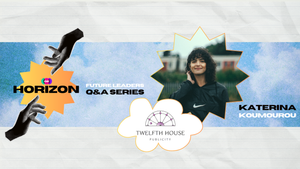
As part of our Horizon series of interviews, we are connecting with the music industry’s current and next generation of leaders to gather candid advice and insights into their career journeys.
This week we caught up with Katerina Koumourou, music publicist and founder of Twelfth House.
Before she landed her first paid role in the industry, Katerina was juggling unpaid internships alongside part-time jobs, running a YouTube channel with a university friend, freelancing for magazines and interviewing artists for her student radio show. It was a lot to hold together, but it’s also exactly the kind of resourcefulness and initiative that the industry rewards.
A BBC panel event eventually led to her first paid job at a management company and from there she found her way into PR. Now she runs Twelfth House, a music PR company she’s been building for the past four years, working alongside labels, managers, distribution companies and radio pluggers to build press campaigns for artists she genuinely believes in.
She’s also co-managing emerging artist Leah Cleaver, whose genre-fluid records have already picked up support from NME, The Independent and DIY Mag.
Her journey is a powerful example of what’s possible when you back yourself without waiting for permission. She didn’t have a straightforward route in and she didn’t wait for one to appear. She created her own evidence, built her own platforms, showed up to every panel and mixer she could, and invested in relationships long before she knew exactly where they’d lead.
Ten years on, the people she went for coffee with when they were all just starting out are now the managers, A&Rs and marketing people bringing her in on campaigns.
What stands out about how she works is how personal it is. The music has to resonate with her before she’ll work with an artist and that genuine belief in what she’s championing comes through in everything she does.
Her advice reflects the same ethos: get in rooms, be curious about people as people rather than focusing on what they can do for you, drop the ego and make sure work doesn’t consume your whole life in the process. Balance isn’t a luxury. It’s what makes the work sustainable.
What’s your current role in the music industry?
I’m a music publicist. I’ve been working in the industry for over ten years and have been running Twelfth House for the past four years.
I usually work as part of artist teams, alongside labels, distribution companies, managers and radio pluggers, to help build out press campaigns for the artists’ upcoming releases. We strategise and focus on key targets that will help to amplify the story of the artist and the project in a meaningful way.
Beyond music, we have also worked with fashion stylists and food content creators who are music-adjacent in their work and who wanted to build out more of a press profile for themselves as a result.
I’m also currently co-managing an artist called Leah Cleaver, who is an exciting emerging artist within the UK, writing and creating genre-fluid records that currently sit across electronic and queer club sounds with jazz-leaning soul vocals that have been praised by the likes of NME, The Independent, DIY Mag and more.
What does your general day to day look like?
Not all weeks and days look the same. Sometimes I arrange meetings and calls with clients to speak through opportunities and press requests that we have secured, and other times we meet with journalists and editors to discuss the artists that we work with.
I also organise “promo days”, where we arrange various in-person interviews, shoots and filmed opportunities for our artists to take place across one day, which can make things a lot easier for our artists who tend to have busy schedules. Other weeks, I’m busy securing coverage and support around new music releases - singles, albums, EPs - so it can get quite email-heavy!
I also arrange pitches via email to select press partners who we’d like to bring on board for certain campaigns, generating interest across press for the artists we work with.
Other day to day tasks include writing press releases, pulling together targets and strategies, and sometimes we get to enjoy seeing our artists perform live at their headline shows, or we take our artists to certain events happening in the culture calendar, or we attend events that our artists throw around project releases.
What steps did you take early in your career to gain experience and build skills to get you where you are now?
I attended a lot of free or cheaply priced industry panels and mixers, as well as attending live music events that would take place at Boxpark Shoreditch.
I know a lot of things have changed since I first joined the industry, but I realised quite early on that if I was going to get anywhere in the industry, networking was the key. So I would make myself physically present whenever I was able to, to find people that I could connect with and find common ground with.
Attending a BBC panel led to my first paid job in the industry at a management company and from there I was able to find my feet in PR.
I would say that my love for writing also helped with my current role. I always loved reading books and creative writing, and I found a lot of enjoyment in writing press releases to describe my clients’ new music. It’s an important aspect of my job to have strong grammar and writing skills as it’s a huge part of my day to day.
Not so much of a skill, but a very important element of working in my role is passion. I am so passionate and excited about the artists that I work with and I believe in their journeys so strongly. The music has to resonate with me in order for me to be able to work with the artists.
What opportunities did you explore early on that were particularly valuable?
Before I even landed my first paid role, I was working unpaid internships alongside my part time paid jobs - not something I would necessarily recommend over a long period of time.
These internships were with management companies during my uni days where I’d help with outreach to venues and university spaces that we wanted artists to perform at, and also a boutique PR agency where I had my first introduction to what music PR actually entailed.
As difficult as it was to juggle, these opportunities were invaluable in giving me insight into the business and industry side of music at that early stage.
Beyond this, I started my own YouTube channel with a uni friend where we would platform emerging talent around our university city, partnering with a local coffee shop who allowed us to use the basement of their cafe in exchange for promoting their coffee shop when we published each live session on YouTube.
I also freelanced for local magazines during my time at university, as well as interviewing artists for my student radio show. These types of opportunities are so key in building relationships with likeminded people who also have a passion for music, and some of the people I met at these early stages have also built out successful careers for themselves.
Has the opportunity landscape changed since then?
From my perspective, I think there has been a huge shift in the landscape since I first started out, but I think only for the better - though I might be wrong!
I don’t think unpaid opportunities are as openly encouraged as they were ten plus years ago, and I feel that the rise of platforms like Instagram and TikTok have allowed young people to identify platforms and companies a lot more easily, and I think connecting with people within creative fields is a lot more accessible because of social media too.
Although some companies have ceased to exist, I can also see that others have emerged since then; Elijah’s Yellow Squares events are incredible and shesaid.so has created a strong network and community of women who work in the creative aspects of music, but also the business side of things, and they host frequent workshops, panels and events.
Aside from these, a lot of publications and venues also arrange events for aspiring young people to gain insight into the industry, with NOTION arranging panels at festivals and Roundhouse Works hosting networking events.
Are there any specific internships, projects, or initiatives that you would recommend to newcomers looking to pursue a similar role?
Look out for magazines and publications who are hiring for junior roles. platforms like NME, Resident Advisor, CLASH Magazine, Mixmag, Notion Magazine and more advertise for roles frequently across their socials and websites.
Sign up to newsletters such as shesaid.so and look at community radio stations such as Reprezent Radio, Westside FM, NTS and Voices Radio. Community stations are such a crucial part of the industry and play an important role for emerging artists.
Join communities like Roundhouse Works, and attend networking events/mixers that are hosted by organisations like UD Music. And also pay attention to what PPL and PRS are doing, as well as organisations like Youth Music and Help Musicians.
What advice do you have for building and leveraging a professional network in the music industry?
I know it’s harder for some people to socialise and push themselves out of their comfort zone by speaking to strangers in a room, and totally understand how daunting it can be, but the people that I connected with and made friends with ten years ago are the same people that I am able to connect with and speak with today.
And those same people also work within the industry in their own ways, whether they are journalists or managers or running their own events or working within labels.
Some of the people I first asked to go for coffee or lunch over ten years ago are now managers who work with artists that I’m running press campaigns for, or they’re A&Rs and marketing managers who are looking for a publicist to bring on board for new artists they’ve signed.
I’d say it’s important to have a genuine interest in getting to know people as opposed to getting to know what they do, don’t just think about how people might be able to benefit you, think about who the person is and what their interests are before anything else.
It’s important to build your community and circle with people who you can resonate with and who you can call on when you’re unsure on what to do next - and to also be that person for them if needed.
If you’re able to go for coffee with someone tomorrow, you never know how that someone might one day next year be able to help you in your journey. Drop any ego and just be yourself - there is no right or wrong when creativity is concerned and I think being open-minded is the key.
How has the evolving digital landscape impacted your role, and where do you focus to stay ahead?
The digital landscape is continually changing and the websites and platforms that I was pitching to ten years ago have changed in a few ways, although some publications have also stood the test of time or have been able to evolve themselves, such as Pigeons & Planes.
A lot of publications are social media facing now to keep up with the ways that people are consuming media and there are a lot less people actually reading magazines and online publications, which I do get concerned about as I love print media.
Other publications such as Drowned In Sound have transitioned into a podcast and newsletter, analysing the ways that the industry continues to change for both musicians/artists and those working within journalism.
Ultimately, my focus is and always has been to find the best platforms that my artists’ stories will align with the most, and to bring more exposure to the stories that they are telling through their music - whether that is now a podcast, or a Substack channel, or a content creator / social media interviewer.
What trends or changes do you see on the horizon for the music industry, and how can early career professionals prepare for them?
I think it’s super important to keep watch of how AI continues to infiltrate the industry and to think about the long-term impact that its role within the industry can have.
I understand that it has its benefits in quickening tasks and making work feel more convenient, but ultimately we have to question how much further we’re willing to “let it in”.
We’re already seeing AI-created artists being pushed across Spotify, AI-written emails and press releases. It might be distinguishable right now but I think it’s important for us to place boundaries on how it’s used and abused.
What’s one piece of advice you wish someone had given you at the start of your career?
Do not let work consume your life and routine, and ensure that you have a healthy balance between your job, your hobbies and your social life.