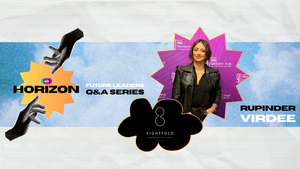
As part of our Horizon series of interviews, we are connecting with the music industry’s current and next generation of leaders to gather candid advice and insights into their career journeys.
Rupinder Virdee began her career in a broom cupboard, literally cutting press clippings out of the stacks of music magazines that existed before the internet changed everything, and pritt-sticking them to paper so executives could see their client coverage each day. It’s a world away from how PR works now and that contrast tells you everything about the scope of experience she’s accumulated.
From there she landed at Arrested PR under powerhouse publicist Jody Dunleavy, where she got her hands on campaigns for Louise Redknapp, Timbaland, Missy Elliott and D12. That grounding in the craft - real, hands-on, unglamorous at times - is the foundation everything else is built on.
Twenty-plus years later, she runs 8 Fold Communications, working with companies, founders and senior leaders across the business of music on corporate communications, reputation management and media strategy.
She also manages artists, something she’s done for the past twenty years alongside everything else, currently working with grime and rap artist Jafro, singer-songwriter Faheem Main and Panjabi singer Jaya. That dual existence, one foot in the institutional side of the industry and one in the creative, is something she sees as central to how she operates.
What’s striking about Rupinder is that she’s always seen the connections others miss. Working across music, film, entertainment, events, community projects and the public sector might look like a winding road from the outside, but for her it’s all been the same thing: storytelling. That ability to move between worlds and join the dots is exactly what makes her so good at what she does now.
Her advice for anyone starting out comes from hard-won experience: don’t wait for the perfect opportunity, create evidence of what you can do. Don’t just network upwards, the assistant you meet today could be running a company in ten years, and the relationships you build with your peers as you all grow into the industry together are often the ones that matter most.
She’s seen this first hand. And if your career doesn’t look linear right now, don’t panic. Hers didn’t either, and it turned out that was the point.
What’s your current role in the music industry?
I’m a strategic communications and PR consultant and run 8 Fold Communications. I work predominantly across the business of music, helping companies, founders and senior leaders build influence, shape their positioning and tell their story.
My work sits somewhere between corporate communications, reputation, media strategy and profile building. I’ve seen the industry from both the institutional and entrepreneurial sides.
I also manage talent and have done on and off for the past 20 years. Currently I manage grime/rap artist Jafro, singer songwriter Faheem Main and Panjabi singer Jaya.
What does your general day to day look like?
Sounds cliched but honestly, no two days look the same. I could be working on a major company announcement in the morning, then shaping a CEO’s positioning, pitching a story to journalists, dealing with a reputational issue or building a communications strategy for a start-up.
A lot of my job is joining the dots. Understanding what is happening in the industry, spotting the bigger story and working out where a client or individual can genuinely add to that conversation.
I do have balance though and love the creative outlet that working with music artists gives me. Seeing talent build and grow, again joining the dots on their journey through collaboration, live shows, studio time and so on.
What steps did you take early in your career to gain experience and build skills to get you where you are now?
I learned by doing. I hadn’t yet left university and landed a job in the “broom cupboard”. We didn’t have digital and modern cutting services, the only one that I remember back then was called ShadowFax.
My job was to literally go through stacks of papers and the tons of music mags we had back then, cut out our clients’ coverage, pritt-stick it to a sheet of paper and essentially build a day’s coverage and make copies for the executives!
My first official role was at Arrested PR with Jody Dunleavy, who was a powerhouse publicist, and who really took a chance on me, it’s where I learnt the craft.
My first ever project was with Louise Redknapp, followed by working with Timbaland, Missy Elliott, D12, Jon B, the Brand New Heavies and Hed Kandi and lots of top charting songs. It was incredibly hands-on and gave me a real grounding in publicity and how the music industry actually works.
But my career hasn’t been linear. I’ve worked across music, film, entertainment, events, community projects, the public sector and brands. At the time, I probably worried that my experience looked too broad. Now I realise that breadth is one of my biggest strengths. In essence it’s still storytelling.
Every role taught me something different and added a string to my bow including, how to understand audiences, manage reputations, influence people, build partnerships and importantly, read a room.
What opportunities did you explore early on that were particularly valuable?
The opportunities where I was given real responsibility were the most valuable.
I worked on campaigns connected to black music, South Asian culture, major international artists and emerging talent. I was often operating across different cultures and audiences, sometimes before the industry really talked about cultural strategy in the way it does now.
I also said yes to opportunities outside a traditional music industry career path. Events, community campaigns, youth projects and public sector work all taught me skills I still use today.
My advice is not to be too obsessed with whether an opportunity looks perfect on LinkedIn. Ask yourself what you are going to learn and who you are going to be exposed to. Very early in my career it was my network that was key to where I am today. The people that are in key roles, powerful positions, we met many years ago and grew into the business together. Stay connected,
Has the opportunity landscape changed since then?
Completely.
There are far more routes into music now, but I personally believe that the landscape today can feel more confusing and overwhelming for new executives. When I started, there were clearer entry-level roles and you learned by being around people who had been doing the job for years.
The media landscape was clearer too - print, radio and TV were more contained. You knew that if you managed to get someone on the BBC News at 6pm, you could land millions of views.
Today, the way that media is consumed is so personal. Everyone chooses a personal feed of what they consume and how. For instance people now don’t watch the news on TV but follow the type of news channels they prefer on social media. This makes the landscape, specifically for comms and marketing, very fragmented.
In order to land your message to a conducive audience, you have to really lean into community, very specific rooms and outlets for the news to land. Then you add in social media and it can become a real spider’s web.
Today, you can build a profile, launch a project, create content or start a business from your bedroom and use AI to do a lot of the work. That is incredibly powerful. But it also means there is a lot of noise and sometimes people feel pressure to look successful before they have had the chance to properly learn their craft.
From my point of view, yes, the opportunities are greater and relatively the world is smaller. But the challenge is developing depth, not just visibility.
Are there any specific internships, projects, or initiatives that you would recommend to newcomers looking to pursue a similar role?
I would actively look for opportunities where you can work on something real. It’s trial and error and getting out there meeting people is the best way to build relationships, in person.
Work with an independent brand or artist. Help a local venue. Volunteer on a music project. Support a start-up or community music organisation. Build a campaign and see whether anyone actually engages with it. Honestly people need help all the time and if you can learn how to craft a story and sell it in, you’re already winning.
I'm on the advisory committee for The BRIT School and I’ve also been involved in creating initiatives to improve access and visibility for underrepresented people in music, including South Asian Women in Music through music:defined. I strongly believe in programmes that connect young people directly with working industry professionals.
But don’t wait for the perfect internship. Create evidence of what you can do.
What advice do you have for building and leveraging a professional network in the music industry?
Don’t just “network”. Build relationships. Today, my network is far and wide and you never know how and where people will grow into the business.
The music industry is smaller than people think and your reputation travels with you. Do what you say you are going to do. Introduce people to each other and don’t worry about holding contacts close, because your relationship will keep them close.
Stay in touch when you don’t need anything. If you see or read something interesting, share it with people and remain in their minds.
Some of the most important relationships in my career have been built over ten or twenty years.
And don't only network upwards. The assistant you meet today could be running a company in ten years. Your peers are often the most valuable network you will ever build. I have first hand experience of this.
How has the evolving digital landscape impacted your role, and where do you focus to stay ahead?
My career has effectively tracked the digital transformation of communications. We’ve moved from traditional press and broadcast being the main gatekeepers to social media, creators, podcasts, newsletters and now AI completely changing how stories are created and distributed.
Having said that, when I first set up on my own, I launched one of the first online PR companies. A lot of my friends and colleagues were moving into working on blogs, websites, a friend became Head Of Music at Bebo, another Head Of Music at MySpace and more.
I was working on a music PR project with Ms Dynamite at the time and offered online media as that’s where the fans set. That was the catalyst to continue building online in addition to traditional press.
I try not to become obsessed with individual platforms. Platforms change. Human behaviour is the more interesting thing for me. How people think the way they do, what interests individuals, how we move the dial.
I focus on how people are discovering information, who they trust and what makes them pay attention. I do love social media and how you can build communities that are rich and invested.
I do and have done a lot of work with social media and yes it can be overwhelming being switched on all the time, but you have to remain in the mix of what’s relevant to readers. I believe that you cannot advise businesses about the future if you’re frightened of using the technology shaping it.
What trends or changes do you see on the horizon for the music industry, and how can early career professionals prepare for them?
I think the biggest shift will be around ownership, value and influence.
AI is going to accelerate questions the music industry was already facing: who owns what, who gets paid and how the people creating value participate in the financial upside. It already has.
At the same time, I think people who can operate between different worlds will become incredibly valuable. Music and technology. Creativity and business. Data and culture. People who can connect others.
Early career professionals should become translators. What I mean by that is don’t just understand one part of the industry but actually learn how the different parts connect. That way you’re across conversations, trends, launches, anything that’s newsworthy.
Yes of course, technical skills and expertise will matter, but curiosity, judgement and the ability to understand people will become even more valuable. Listen to what people are saying and stay in the mix.
What’s one piece of advice you wish someone had given you at the start of your career?
Your career doesn’t have to make sense while you’re building it. Mine has taken turns, loops and everything in-between!
For years, I thought I had done too many different things and worked across too many sectors. I now realise I was building a career that allowed me to see connections other people sometimes miss.
So I would tell my younger self to stop worrying about whether your career looks linear. I listened to Tom Toumazi, who is an incredible media executive and CEO, who talks about plural careers and it’s where I, and other music industry entrepreneurs sit… multiple specialisms and the ability to connect the dots. It can be a powerful mix.
Learn everything you can. Stay curious and build relationships. If you can do that in person, I believe that those relationships will grow and thrive.
The dots usually connect later.